Imagine it is Friday afternoon in January 2026. You have just finished your annual performance review. You met every KPI, worked late nights, and covered for colleagues. Yet, the offer on the table is a 3.5% raise—barely covering the 2.4% inflation rate—and a vague promise of “future opportunities.” Meanwhile, a colleague who manages the new Agentic AI workflow just secured a 15% jump and a flexible 4-day schedule. This is not a failure of effort; it is a failure of strategy. According to the latest WTW 2025 Salary Budget Planning Report, the era of automatic aggressive salary hikes is over. The market has shifted, and treating your career with the same vague hopefulness as 2023 will leave you behind. It is time to stop being a passive employee and start running your life with the rigor of a corporate strategist.

1. Assessment of Your Career Portfolio Using the BCG Matrix
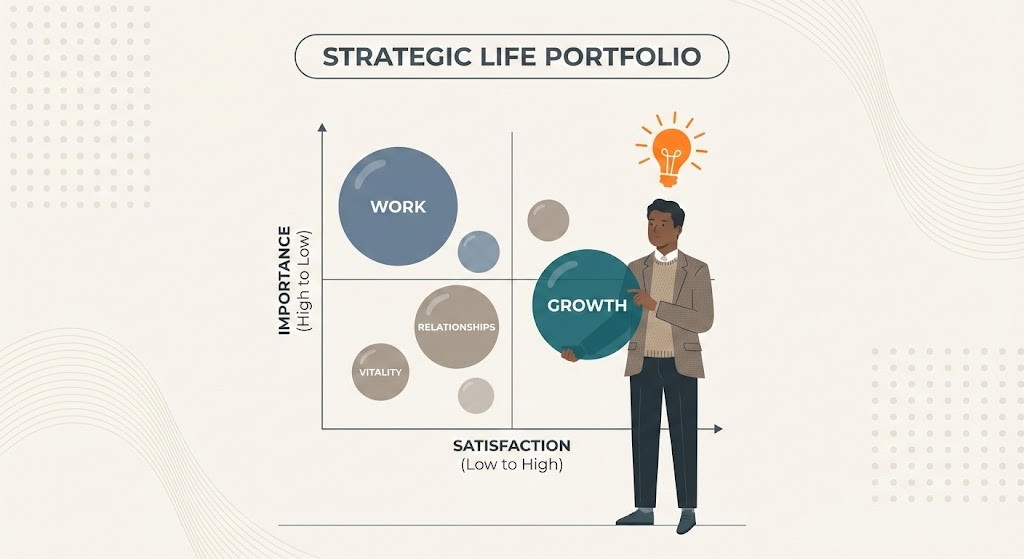
Corporations do not invest resources randomly; they analyze their product lines to decide what to grow and what to cut. Harvard Business Review’s “Strategize Your Life” framework suggests you must do the same. Most professionals drift because they treat every aspect of their life—work, family, health, community—as equally urgent. This leads to burnout without progress. You need to map your activities on a matrix of Importance versus Satisfaction.
1.1 Identifying Your Strategic Life Units
First, define your Strategic Life Units (SLUs). These are the core buckets where you spend your time and energy. For a typical professional, these might include “Core Job Role,” “Professional Networking,” “Family Time,” and “Upskilling.” In 2026, if you are not explicitly allocating resources to “AI Adaptation,” you are likely underinvesting in your R&D department. Write down your top 6-8 units.
1.2 Categorizing Activities into Stars, Question Marks, and Dogs
Once defined, place them on the grid. A “Star” is high importance and high satisfaction—this is where you should double down. A “Cash Cow” is high importance but low satisfaction; this is likely your current day job that pays the bills but drains you. The danger zone is the “Dog” quadrant: low importance and low satisfaction. These are the time-wasters like doom-scrolling or attending vague meetings that yield no results. Your strategy for 2026 must be to minimize “Dogs” and invest in “Question Marks” (high satisfaction, potential high importance) to turn them into future Stars.
| Portfolio Category | Description | Typical Career Example (2026) | Strategic Action Required |
|---|---|---|---|
| Star | High Importance, High Satisfaction | Leading a high-impact Agentic AI integration project. | Invest Heavily: Allocate prime hours here. |
| Cash Cow | High Importance, Low Satisfaction | Routine reporting or legacy system maintenance. | Maintain Efficiently: Do not over-deliver; automate where possible. |
| Question Mark | Low Importance, High Satisfaction | Learning a new language or starting a side consulting gig. | Test & Experiment: Give it a timeline to prove value. |
| Dog | Low Importance, Low Satisfaction | Attending status meetings with no agenda. | Liquidity/Divest: Stop doing this immediately. |
2. Analysis of 2026 Market Demand and Agentic AI Trends
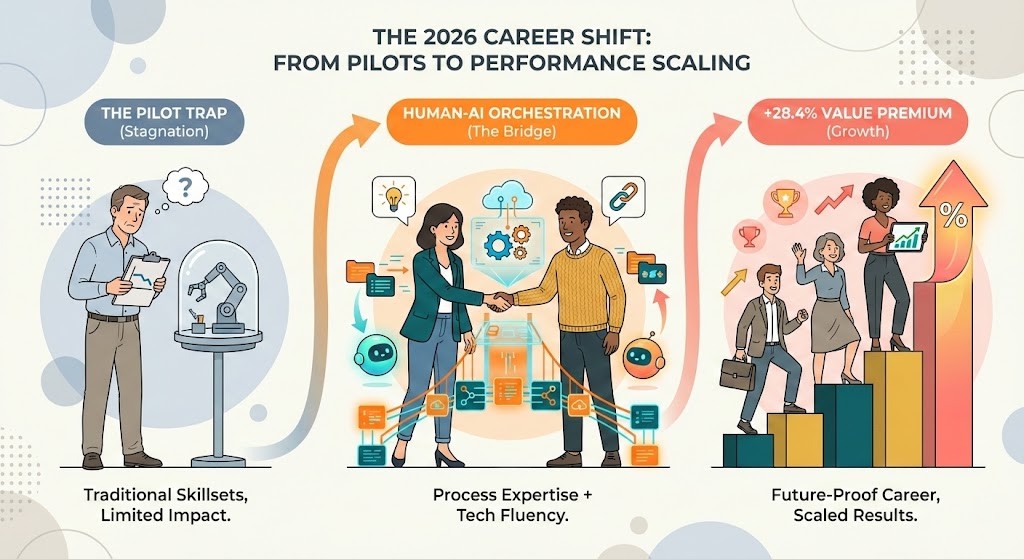
The job market data for early 2026 sends a clear signal: the premium for “hard work” has evaporated. The premium for “strategic oversight” has exploded. According to Gartner’s Top Strategic Technology Trends for 2025 & 2026, we have moved past the era of simple Chatbots to “Agentic AI”—autonomous agents that can execute goals, not just answer questions. If your resume highlights your ability to “execute tasks manually,” you are marketing a depreciating asset.
2.1 Shift from Creation to Orchestration
In the past, being a good writer or coder was enough. Now, AI agents handle the bulk of drafting and coding. The value has shifted to the “Orchestrator”—the person who can define the strategy for the AI agents, audit their output for hallucinations, and integrate their work into business goals. Your career narrative needs to pivot from “I built this” to “I directed the autonomous systems that built this.”
2.2 Confronting the Skills Mismatch
The ILO World Employment and Social Outlook 2025 reports a global unemployment rate of 5.0%, which seems stable. However, this masks a severe “skills mismatch.” Employers have open budget for roles that combine domain expertise with AI literacy but are freezing hiring for traditional roles. You must audit your skills against the current market “buy” list. If your primary skill is listed as a “commodity,” you are vulnerable regardless of your seniority.
| Skill Category | 2023 Value Proposition | 2026 Value Proposition | Market Verdict |
|---|---|---|---|
| Information Processing | “I can summarize complex reports quickly.” | “I configure agents to summarize reports and audit the insights.” | Pivot or Perish |
| Content Creation | “I write excellent marketing copy.” | “I design the brand voice prompts for our content scaling engine.” | Evolve |
| Decision Making | “I follow the playbook.” | “I use data to rewrite the playbook for AI efficiency.” | High Demand |
3. Evaluation of Total Rewards Beyond Basic Salary
When you negotiate your compensation in 2026, looking only at the base salary is a strategic error. With salary budgets stabilizing around 3.5% in developed markets, the room for massive pay jumps is limited for internal promotions. You must adopt the PERMA-V model (Positive emotion, Engagement, Relationships, Meaning, Accomplishment, Vitality) to assess the “Total Rewards” package.
3.1 Quantifying Non-Monetary Assets
Is a $100,000 job that requires 60 hours a week and offers zero flexibility better than a $90,000 job that offers a 4-day work week and full remote options? Mathematically, the second job pays more per hour. In 2026, “Vitality” (physical and mental health) and “Autonomy” are currency. Negotiate for educational stipends to learn Agentic AI tools, sabbatical leaves, or hybrid work setups. These have tangible market value that often exceeds a 2% incremental raise.
3.2 Structuring the Ask
Do not go into a negotiation asking for “more money because inflation is high.” That is not a business case; that is a complaint. Frame your request around the portfolio value you deliver. “By automating the reporting workflow (Cash Cow), I freed up 10 hours a week to launch the new client integration pilot (Star), which is projected to increase revenue by X%.” You are selling your shift from low-value maintenance to high-value innovation.
4. Implementation of Time Allocation Strategy for 168 Hours
Strategy without execution is merely a wish. We all have the same resource: 168 hours a week. A common failure mode is the “Peanut Butter Approach”—spreading your time thinly across everything. You need to benchmark your time allocation against your strategic goals. If you decided that “Upskilling in AI” is a Star activity, but your calendar shows 0 hours dedicated to it, your strategy is failing.
4.1 auditing Your Weekly Calendar
Track your time for one week. Be honest. How many hours went to “Dogs” (low value/low satisfaction)? The average professional wastes 15-20 hours a week on low-value tasks. Your goal is to reclaim just 5 of those hours. You do not need to find more time; you need to reallocate the waste. This is your “R&D Budget” for your future career.
4.2 The 168-Hour Redistribution Plan
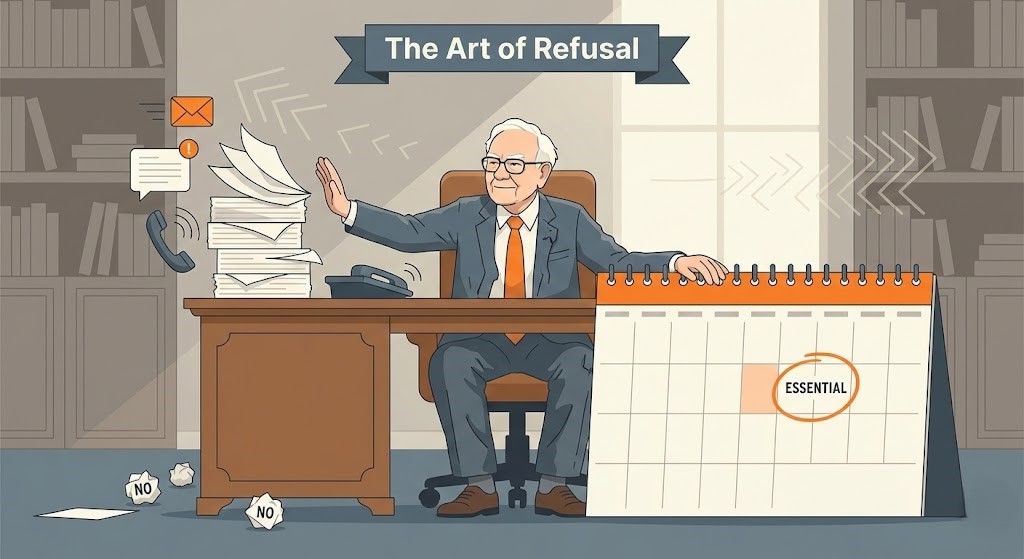
Commit to a rigid schedule for your “Star” activities. Treat your personal growth time with the same respect you give a client meeting. If it is not on the calendar, it does not exist. Use the table below to shift your time allocation starting next Monday.
| Activity Type | Current Allocation (Avg) | Target Allocation (Strategy) | How to Achieve the Shift |
|---|---|---|---|
| Sleep & Health (Vitality) | 49 Hours (Unpredictable) | 56 Hours (Protected) | Non-negotiable sleep schedule. Health is the foundation of strategy. |
| Core Work (Cash Cow) | 50 Hours (Inefficient) | 40 Hours (Focused) | Use AI tools to automate routine tasks; set strict boundaries. |
| Future Growth (Star) | 2 Hours (Sporadic) | 10 Hours (Deep Work) | Reallocate time saved from Core Work; block calendar 8-10 AM. |
| Waste (Dog) | 15 Hours (Doomscrolling) | 5 Hours (Limited) | Digital detox; delete apps; decline non-essential meetings. |
References
- Rainer Strack, “Strategize Your Life”, Harvard Business Review, 2024.
- WTW, “2025 Salary Budget Planning Report”, July 2025.
- Gartner, “Top 10 Strategic Technology Trends for 2025 & 2026”, October 2025.
- ILO, “World Employment and Social Outlook: Trends 2025”, January 2025.
Disclaimer
This article provides general career and life strategy information based on data available as of January 2026. It does not constitute professional career counseling or financial advice. Market conditions vary by region and industry. Readers should conduct their own due diligence before making significant career or financial decisions.