It’s January 2026. You look around your open-plan office, and it feels quieter than last year. Your company hasn’t officially announced layoffs, yet the “hiring freeze” has lasted for 14 months. Meanwhile, a former colleague who quit last year just posted on LinkedIn about hitting $200k in revenue with a team of… zero. Just her and a stack of AI agents. You feel that knot in your stomach—the mix of “Job Hugging” anxiety and the fear of missing out. This isn’t just your imagination. The labor market has fundamentally fractured, and the rules of survival have been rewritten overnight.
1. The Job Singularity: Why “Safe” Jobs Are Vanishing
Let’s rip the bandage off. The traditional corporate ladder isn’t just broken; it has been vaporized. Vlad Tenev, CEO of Robinhood, recently argued that we are approaching a “Job Singularity”—a point where AI doesn’t just assist us but fundamentally changes the nature of work. But for the average professional in 2026, this philosophical concept feels like a very real, very cold shower.
1.1 The “Job Hugging” Phenomenon
If you feel stuck in your current role because the external market looks terrifying, you are not alone. We are seeing a massive spike in “Job Hugging”—employees clinging to dissatisfied roles because AI has decimated entry-level and mid-level execution roles. The data supports this fear. According to the 2025 Upwork Future Workforce Index, while freelance opportunities have surged, traditional full-time roles in data entry, basic coding, and copywriting have contracted sharply. The “safe” middle-class job that pays for showing up and doing routine tasks is extinct.
1.2 The Two Paths: Obsolescence or Augmentation
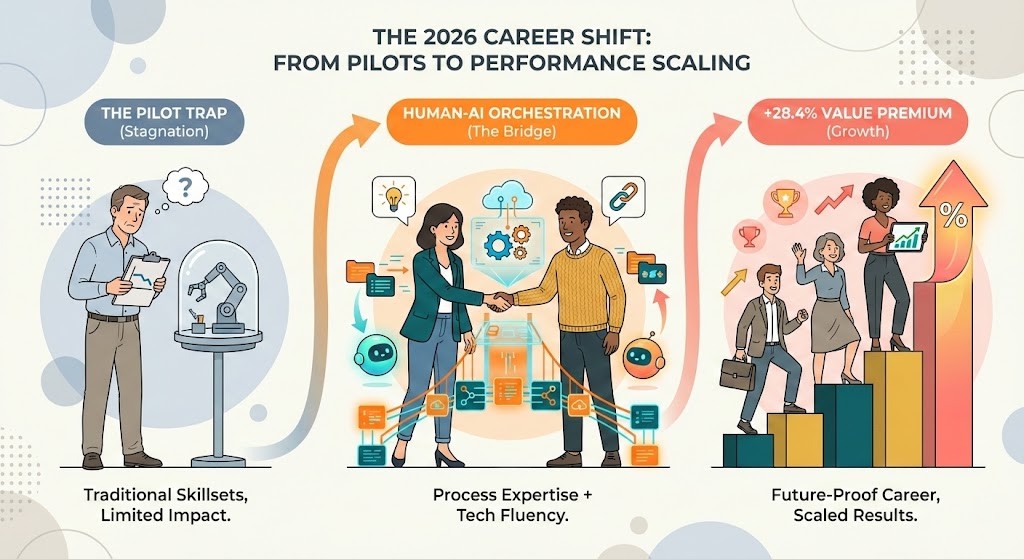
The workforce is splitting into two distinct camps. On one side, we have the “Executors”—those who wait for instructions. These roles are being eaten alive by AI agents that cost pennies on the dollar. On the other side, we have the “Orchestrators.” These are individuals who may not be better coders or writers than the AI, but they know how to direct the AI to get a result. The gap between these two groups is widening into a canyon.
| Metric | The Traditional Employee (2020s) | The AI-Augmented Professional (2026) | Survival Strategy |
|---|---|---|---|
| Primary Value | Execution (Doing the work) | Orchestration (Directing the workflow) | Shift focus from “how” to “what” and “why”. |
| Competition | Other humans in the office | Global talent & AI Agents | Niche down. Generalists are replaced; specialists are amplified. |
| Career Path | Linear Promotion (Junior to Senior) | Portfolio Career (Multiple income streams) | Diversify income sources immediately. |
2. Redefining Success: The Era of the Micro-Corporation
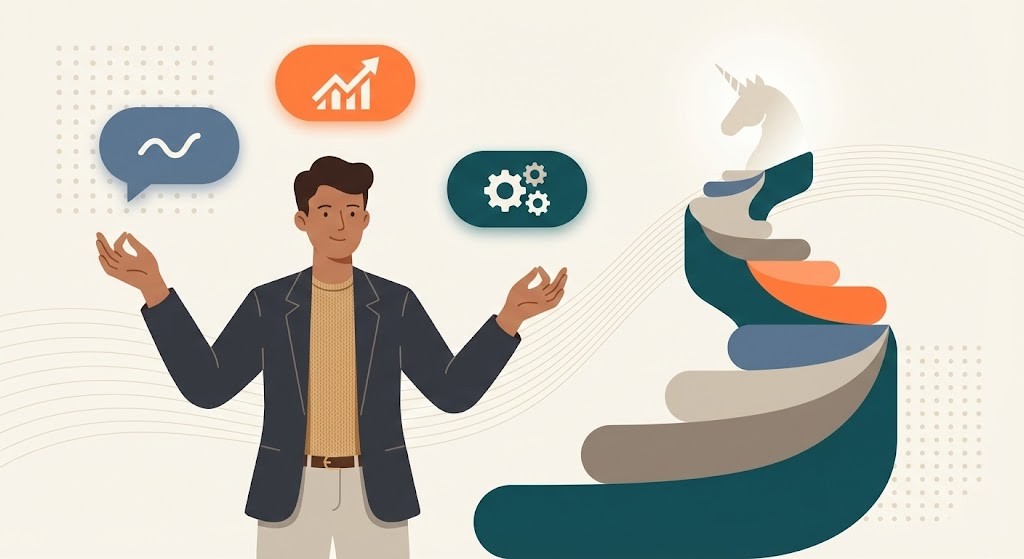
We need to talk about “Unicorns.” In the venture capital world, a unicorn is a company worth $1 billion. But for you, the individual professional, that metric is useless vanity. The real revolution in 2026 is the rise of the “Solo Unicorn” in a functional sense: a one-person business (Micro-Corp) that operates with the efficiency and output of a 50-person traditional company.
2.1 Revenue per Employee: The New North Star
Look at the new breed of startups like Gumloop or the explosion of high-revenue creators. They aren’t hiring hundreds of people. They are hiring software. A single operator today can run marketing, sales, customer support, and product development simultaneously using an agentic AI stack. This isn’t about working harder; it’s about leverage. The goal is no longer to manage a large team of humans (which is stressful and expensive) but to manage a fleet of AI agents.
2.2 The Economics of “Me, Inc.”
Why does this matter to you? Because the barrier to entry for starting a business has collapsed. You don’t need venture capital; you need a subscription to a few AI tools and a distinct point of view. The risk isn’t in starting; the risk is remaining solely dependent on a single employer who is actively looking to automate your role.
| Cost Item | Traditional Agency Model | Solo Micro-Corp Model | Impact on You |
|---|---|---|---|
| Staffing | High (Salaries, Benefits, HR) | Low (Software Subscriptions) | You keep the profit margins. |
| Scalability | Linear (Hire more people to grow) | Exponential (Spin up more servers) | Growth doesn’t equal more headaches. |
| Agility | Slow (Meetings, approvals) | Instant (Decision = Execution) | You can pivot faster than any corporation. |
3. From Employee to Orchestrator: Your 3-Step Pivot
Stop waiting for permission. You don’t need to quit your job today, but you must start acting like a Micro-Corp within your current role immediately. Here is the framework to transition from a vulnerable employee to an antifragile orchestrator.
3.1 Step 1: The Ruthless Audit
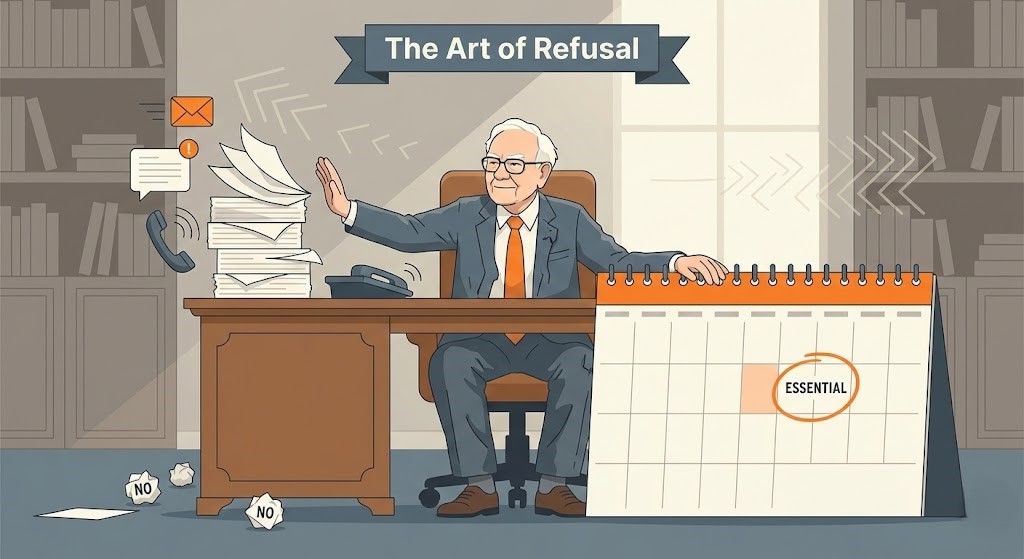
Track your time for one week. Identify every task that is repetitive, logic-based, and digital. Email sorting, data entry, meeting summaries, basic research. These are not “work” anymore; they are inefficiencies. If you are spending more than 20% of your time on these, you are training your replacement. Your goal is to automate these using tools available to you now, freeing up brain space for high-level strategy.
3.2 Step 2: Build Your “Agentic” Team
Don’t just use ChatGPT to write emails. Build workflows. Use tools that connect apps (like Zapier’s AI features or custom GPTs) to create “agents” that work for you while you sleep. For example, instead of manually checking competitor prices, build a scraper agent that delivers a morning report. You become the manager of these bots. This shift in mindset—from “doing” to “managing bots”—is the single most important skill of 2026.
4. When Passion Pays: The Industrialization of Leisure
Vlad Tenev made a provocative point: “Leisure is becoming work.” Gaming, podcasting, curating, and critiquing—things we used to do for fun—are now legitimate economic engines. Why? Because in a world of AI-generated content, human taste is the scarcity.
4.1 Taste as a Service (TaaS)
AI can generate a million images, but it cannot decide which one is “cool.” That requires human context and cultural intuition. Your obsession with vintage watches, your deep knowledge of indie coffee, or your critique of sci-fi novels isn’t a hobby; it’s a data set. By curating this “taste” and packaging it (via newsletters, specialized video content, or consulting), you monetize your humanity.
4.2 The Long Tail Opportunity
Mass markets are for big corporations. Your opportunity lies in the “long tail”—niche markets so specific that big players ignore them, but AI allows you to serve them profitably. A global audience of 1,000 true fans who pay you for your specific expertise is enough to sustain a Micro-Corp.
| Execution Stage | What to Stop Doing | What to Start Doing | Tool/Mindset |
|---|---|---|---|
| Phase 1: Awareness | Ignoring AI updates / Fear | Daily 30-min AI experimentation | Curiosity > Fear |
| Phase 2: Leverage | Manual repetitive tasks | Building standard operating procedures (SOPs) for AI | Documentation |
| Phase 3: Ownership | Selling hours for money | Selling outcomes/products | Productize Yourself |
References
- Upwork Research Institute, “Freelance Forward: The Future of Workforce 2025”, 2025.
- Vlad Tenev (TED AI), “AI is Coming for Your Job. Now What?”, 2025/2026.
- CB Insights, “The State of Venture & AI Unicorns 2025”, 2025.
Disclaimer
This content is for informational purposes only and does not constitute career or financial advice. The employment landscape is volatile; please consult with professional advisors before making significant career changes.