The global markets woke up to a shock on January 20, 2026. Following Prime Minister Keir Starmer’s statement that Donald Trump’s 10% tariff threat over the refused sale of Greenland is “completely wrong,” anxiety has swept through London and Copenhagen. However, while headlines scream about a new trade war, smart capital is quietly moving elsewhere. This is not just about land; it is about the critical resources buried beneath the ice. We analyze why this geopolitical friction is the ultimate buy signal for the Rare Earth sector.
1. Analyzing the Geopolitical Conflict Over Greenland
The recent exchange between Washington and London has escalated beyond typical diplomatic rhetoric. When Prime Minister Keir Starmer publicly rejected the idea of selling Greenland, calling the subsequent tariff threats “completely wrong,” it signaled a deepening fracture in the transatlantic alliance. However, investors must look past the political theater. The core issue is not territorial sovereignty in the traditional sense, but resource security.
1.1 The Real Motivation Behind the Purchase Offer
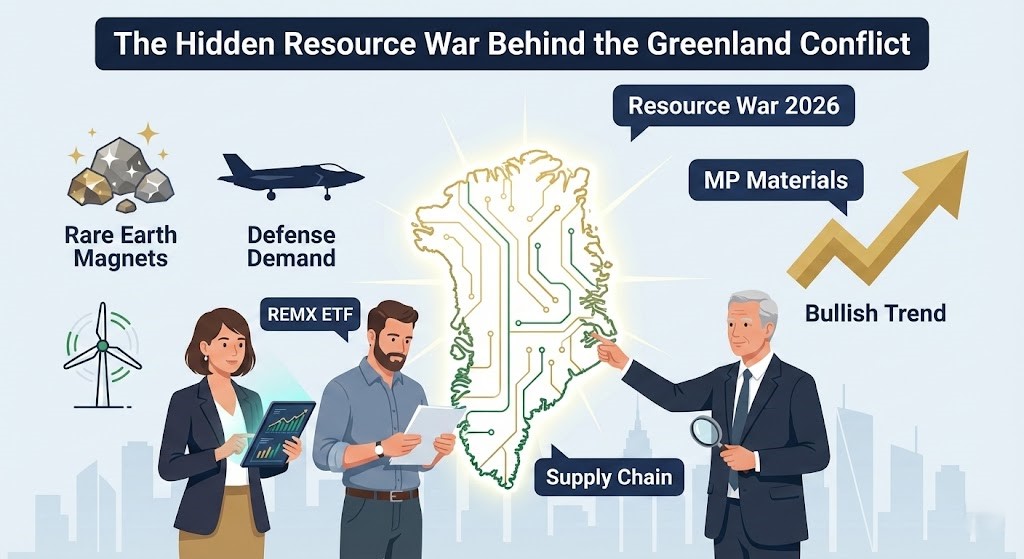
Why is the United States willing to risk a trade war with its closest allies over an icy island? The answer lies in geology. Greenland holds one of the world’s largest undeveloped deposits of Rare Earth Elements (REEs). As of January 2026, the US is aggressively seeking to decouple its supply chain from competitors. Control over Greenland’s resources would effectively secure the raw materials needed for the next century of American technological and military dominance. The 10% tariff threat is likely a negotiation lever to force access to these mining rights, rather than a genuine desire to tax British goods.
1.2 Market Reaction to Political Noise
Historically, geopolitical noise creates temporary volatility but structural trends drive long-term returns. While the FTSE 100 and European indices may suffer from tariff fears, sectors directly related to the underlying cause of the conflict—strategic resources—are outperforming. The market is pricing in a scenario where the value of non-Chinese rare earth supplies skyrockets, regardless of who legally owns Greenland. This is a classic case of “Resource Nationalism” returning to the global stage.
| Event Analysis | Diplomatic Narrative | Economic Reality | Investment Implication |
|---|---|---|---|
| Trump’s Tariff Threat | Punishment for refusing land sale | Leverage to secure mining rights | Volatility in EU export stocks; Bullish for US resource miners |
| UK/Denmark Rejection | Defense of Sovereignty | Protection of strategic assets | Increased valuation of existing Western supply chains |
| Market Response | Fear of Trade War | Flight to Strategic Safety | Capital flow into Rare Earths (MP) and Defense (LMT) |
2. The Strategic Importance of Rare Earth Elements
Rare Earth Elements are the oil of the 21st century. They are non-negotiable components in electric vehicles, wind turbines, smartphones, and most importantly, advanced military hardware. The conflict over Greenland is a symptom of a severe supply-demand imbalance that is coming to a head in 2026.
2.1 Supply Chain Vulnerabilities
For decades, the West relied on cheap imports for these critical minerals. That era is over. With supply chains fracturing and geopolitical tensions rising, the premium for “secure” supply has reached historic highs. A fighter jet like the F-35 requires hundreds of kilograms of rare earth materials. Without a secure supply, national defense is compromised. This reality is what drives the valuation of companies that can extract and process these elements within safe jurisdictions.
2.2 The Valuation of Resource Security
In the current market environment, companies are no longer valued solely on their earnings per share (EPS). They are valued on their strategic importance. A company that provides the US military with essential magnets commands a “Security Premium.” This explains why valuations in this sector have detached from traditional mining metrics. Investors are paying for the certainty of supply in an uncertain world.
| Key Element | Primary Application | Supply Risk Level (2026) | Direct Beneficiary |
|---|---|---|---|
| Neodymium (NdPr) | High-performance magnets (EVs, Wind) | Critical / High | MP Materials (MP) |
| Dysprosium | High-temperature magnets (Military) | Severe / High | Strategic Miners |
| Cobalt/Lithium | Battery Storage | Moderate (Supply stabilizing) | Global Mining ETFs |
3. Investment Analysis of Key Rare Earth Stocks
Given the macro backdrop, how should an individual investor position their portfolio? We focus on three distinct instruments: the market leader, the diversified ETF, and the defense proxy.
3.1 MP Materials (MP): The Pure Play Leader
MP Materials stands as the only scaled producer of rare earth materials in the Western Hemisphere. As of January 20, 2026, the stock is trading at $68.98, reflecting a massive surge over the past year. The company’s Mountain Pass facility is a strategic asset for the United States. Unlike junior miners that are years away from production, MP is generating cash flow and delivering product today. The current valuation reflects its status as a monopoly-like asset in the US supply chain. While the price has risen significantly, the long-term contract structures and government support provide a floor to the stock price.
3.2 VanEck Rare Earth ETF (REMX): The Diversified Approach
For investors concerned about the operational risks of a single mine, the VanEck Rare Earth/Strategic Metals ETF (REMX) offers a balanced alternative. Trading at $89.18, REMX holds a basket of global companies involved in the production and recycling of critical materials. This ETF captures the upside of the sector while mitigating the risk of a specific company failing. It is particularly attractive for those who believe in the “Resource War” thesis but want to avoid the volatility of individual stock picking.
3.3 Lockheed Martin (LMT): The Defense Connection
While not a miner, Lockheed Martin (LMT) is inextricably linked to this theme. Trading at $582.33, LMT is the end-user of these materials. The tension in Greenland and the Arctic directly translates to higher defense spending on ice-capable surveillance and F-35 deployments. LMT serves as a hedge; if the conflict escalates, defense spending rises. If the supply chain is secured, their production costs stabilize. It provides a lower-beta exposure to the same geopolitical theme.
4. Future Market Scenarios and Action Plan
The market is currently pricing in a high probability of continued friction. Investors need a clear plan that accounts for both escalation and resolution scenarios.
4.1 Bull and Bear Cases
In the Bull Case for these stocks, the US government imposes stricter mandates on sourcing, effectively banning foreign rare earths for defense contracts. This would send MP and REMX significantly higher as demand becomes inelastic. In the Bear Case, a sudden diplomatic resolution and the lifting of tariff threats could cause a short-term pullback in prices as the “fear premium” evaporates. However, the long-term supply deficit remains a structural reality that supports higher prices over the decade.
4.2 Strategic Allocation for Individual Investors
Do not chase green candles blindly. The rapid ascent of MP Materials suggests that a pullback is possible and healthy. The smart strategy is to accumulate positions during days of diplomatic calm, rather than panic-buying during headline news. Use the volatility to your advantage. A mix of the ETF for the core holding and the individual stock for alpha generation is a prudent approach.
| Action Item | Aggressive Strategy | Balanced Strategy | Conservative Strategy |
|---|---|---|---|
| Primary Vehicle | MP Materials (MP) | 50% MP / 50% REMX | REMX ETF |
| Entry Tactic | Buy on intraday dips | Dollar Cost Average (Weekly) | Buy after 5% correction |
| Monitoring Metric | Rare Earth Oxide Prices | US-EU Trade Talks | Global Defense Budgets |
References
- Bloomberg Television, “Greenland: Starmer Says Trump’s Tariffs Threat Is ‘Completely Wrong'”, 2026.
- Precedence Research, “Global Rare Earth Elements Market Size & Trends Report”, 2025.
- VanEck, “REMX ETF Fact Sheet and Performance Data”, 2026.
Disclaimer
This content is for informational purposes only and does not constitute financial advice, an offer to sell, or a solicitation of an offer to buy any securities. All investments involve risk, including the loss of principal. Please consult with a qualified financial advisor before making any investment decisions. The views expressed are those of the author as of January 20, 2026, and are subject to change without notice.