Imagine you have finally mustered the courage to quit your stable 9-to-5 job to pursue your dream as a full-time creator. You spend 40 hours editing a masterpiece, only to see it flatline at 100 views with an average view duration of 12 seconds. It feels like shouting into a void. In 2026, the global creator economy has reached a staggering $500 billion valuation, yet 95% of new entrants fail not because of poor production, but because they lack the psychological architecture of a story. This is the reality of the attention recession: if you do not hook their brain in 2.5 seconds, you do not exist.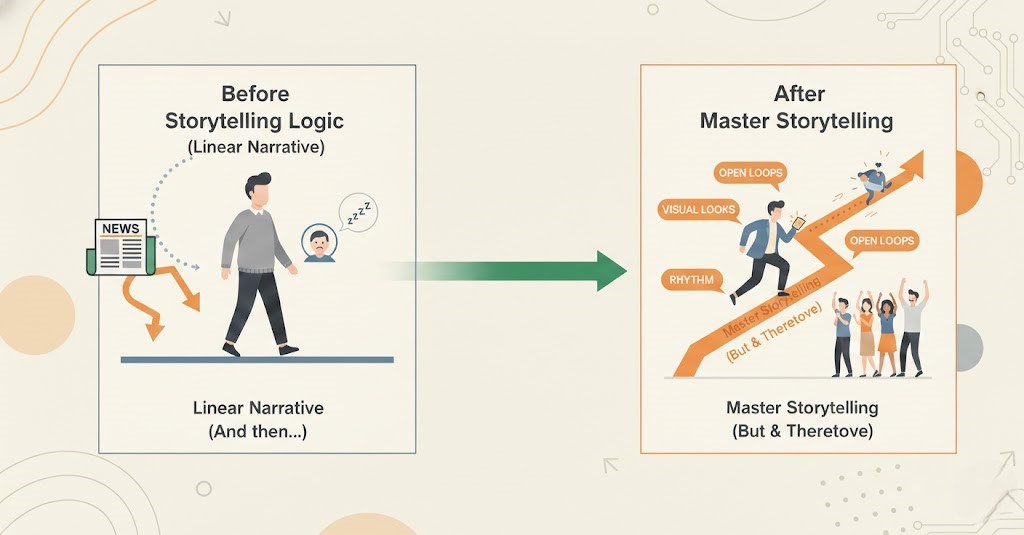
1. The Architecture of Conflict and Context
Most creators treat storytelling as a straight line, but the human brain is wired to respond to a pulse. This pulse is created by the constant oscillation between giving the audience information and introducing a new problem.
1.1 Building the Open Loop System
An open loop is a psychological tension where the brain demands a resolution. When you provide context—telling people who you are and what you are doing—you must immediately follow it with a conflict that threatens that mission. This keeps the viewer asking, ‘What happens next?’ rather than ‘Why am I watching this?’
1.2 Avoiding the Information Dump
The biggest mistake in wellness or financial content is the ‘and then’ syndrome. Listing facts one after another is a lecture, not a story. To maintain a retention rate above 60% in 2026, you must ensure every piece of context exists solely to raise the stakes for the next conflict.
| Analysis Item | Traditional Approach | Modern Master Strategy | Practical Action Plan |
|---|---|---|---|
| Structure | Chronological listing (And then) | Causal progression (But/Therefore) | Audit your script for ‘And then’ and replace them with pivots. |
| Viewer Engagement | Passive consumption of facts | Active problem-solving | Pose a question every 45 seconds to keep the mental loop open. |
| Retention Goal | Completing the video | Earning the next 10 seconds | Treat every segment as a mini-story with its own hook and resolution. |
2. The But and Therefore Logic System
As pioneered by the creators of South Park, the secret to a gripping narrative lies in two simple words: ‘But’ and ‘Therefore’. These words create the causal links that make a story feel inevitable yet surprising.
2.1 Eliminating Linear Boredom
If your script can be summarized as ‘X happened, and then Y happened, and then Z happened,’ it is boring. A master storyteller writes: ‘X happened, BUT Y got in the way, THEREFORE we had to try Z.’ This forces the narrative to change direction, preventing the viewer’s brain from going onto autopilot.
2.2 The Power of the Head Fake
In the 2026 content landscape, predictability is the enemy. Use ‘But’ to create head fakes—moments where the audience thinks they know the outcome, only for you to reveal a hidden complication. This is especially effective in professional development and wellness niches where the ‘obvious’ advice is often ignored.
3. Sentence Variation and Rhythmic Delivery
Rhythm is the invisible hand that guides attention. If every sentence you speak or write has the same length, your content becomes white noise. Master creators like Kallaway or Emma Chamberlain use sentence length as a musical tool.
3.1 Writing Music Instead of Words
Varying between short, punchy statements and long, flowing explanations creates a ‘lilt’ that is soothing to the ear. Short sentences create urgency. Long sentences build momentum and energy. When combined, they prevent the ‘drone effect’ that causes viewers to scroll away.
3.2 The Visual Script Audit
When writing your content, look at the right margin of your script. If it looks like a straight line, your rhythm is dead. Aim for a jagged edge. This visual representation ensures that you are mixing your sentence structures to keep the subconscious mind of your audience engaged and alert.
| Rhythm Element | Effect on Audience | Optimal Usage | 2026 Benchmark |
|---|---|---|---|
| Short Sentences | Increased heart rate, urgency | Use for hooks and key takeaways | Average 5-7 words for high impact. |
| Medium Sentences | Standard information delivery | Use for building context | The ‘bridge’ between logic points. |
| Long Sentences | Crescendo, emotional build-up | Use for the ‘Big Reveal’ or ‘The Why’ | Should burn with energy and purpose. |
4. Visual Hook Mastery and Final Execution
The era of audio-first content is over. In a world of silent scrolling and rapid-fire visual stimuli, what the viewer sees is ten times more important than what they hear in the first three seconds.
4.1 The 2.5-Second Visual Rule
Human eyes process images faster than the ear processes language. If you are talking about a specific problem, that problem must be visually represented on screen instantly. A vivid, high-contrast visual hook acts as a confirmation of the title, telling the viewer’s brain that they are in the right place.
4.2 The Last Dab and the Loop
Ending a story is as important as starting it. Your final line should be a ‘last dab’—a memorable, sharable statement that encapsulates your entire message. For social media, design this last line to lead seamlessly back into the first line of your hook, creating an infinite loop of engagement.
| Execution Phase | Current Baseline | Future-Proof Strategy | Expected Outcome |
|---|---|---|---|
| Visual Hook | Generic face-to-camera | High-relevance object/text overlay | 30% increase in 3-second retention. |
| Tone | Talking ‘at’ the audience | Talking ‘with’ a close friend | Higher trust and community conversion. |
| Closing | Generic call to action | The ‘Last Dab’ + Loop design | Increased shares and re-watch frequency. |
References
- The Creator Economy Report, HubSpot Research, 2025
- Digital Storytelling Impact Analysis, Content Marketing Institute, 2025
- The Neuroscience of Narrative Retention, Journal of Cognitive Media, 2026
Disclaimer
This article is for informational purposes only and does not guarantee specific social media growth. Consult with a professional brand strategist for tailored advice. All data is based on 2026 market projections.