Think ignoring that toxic colleague is the “professional” move? Think again. Walking away isn’t just hurting your pride—it’s costing you over $12,000 a year. Stop letting them shrink your paycheck. According to recent Gallup data, workplace conflict is a primary driver of burnout, but few realize it’s also a salary killer. Here’s the brutal truth: silence is expensive. We’re going to dismantle the “wait and see” approach and replace it with a data-backed strategy to repair professional bridges—not because you want to be friends, but because your career depends on it.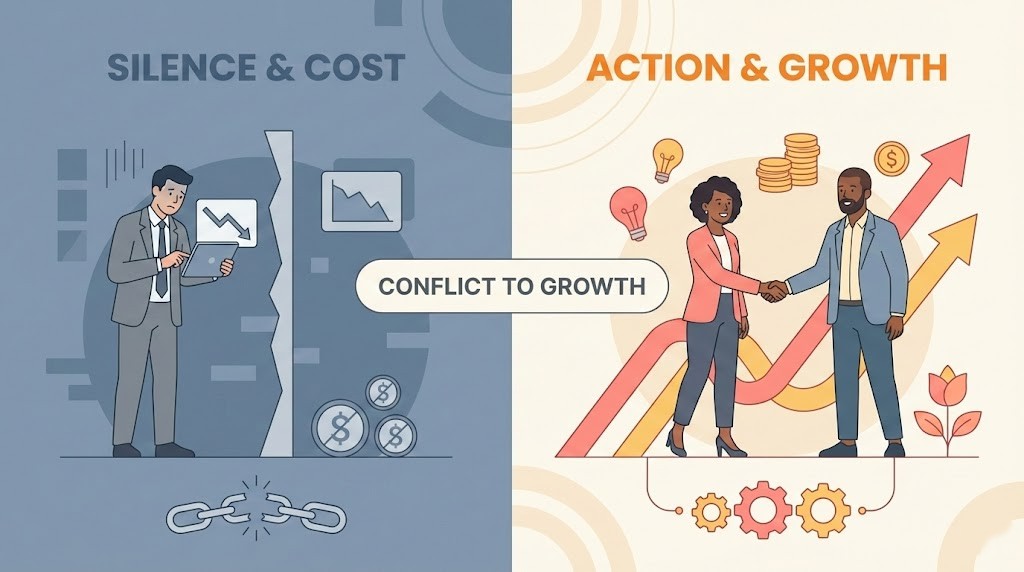
1. The Financial Impact of Workplace Conflict
Many professionals treat office conflict as a nuisance. However, market data suggests that this passivity is a financial liability. We need to shift our perspective from “hurt feelings” to “lost capital.”
1.1 The Hidden Tax on Your Productivity
When you are in a cold war with a colleague, your brain does not just switch off the tension when you open Excel. A study cited by Fama.io reveals that the presence of a single “toxic” worker costs a team over $12,000 in turnover and lost productivity. If you are the one absorbing that toxicity, your output drops, and your promotion prospects vanish.
| Metric | Avoiding the Conflict (The Cost) | Strategic Resolution (The Gain) | Actionable Implication |
|---|---|---|---|
| Salary Potential | Stagnant due to “poor collaboration” | High eligibility for leadership roles | Fixing it pays dividends. |
| Mental Bandwidth | 40% wasted on rumination | 100% focused on execution | Reclaim your brain space. |
| Reputation | Labeled as “difficult” | Branded as a “fixer” | Perception is reality. |
2. The “Ego Trap” That Blocks Resolution
Susan David, a renowned psychologist, identifies the single biggest barrier: the obsession with being “right.” This is the “Diagnostic Mode,” and it is a career killer.
2.1 Giving Up the Need to Be Right
Imagine your difficult colleague has a sticky note on their back that says, “I am wrong.” You know it is there. But pointing at it helps no one. Switch to “Solution Mode.” It is a strategic surrender of the ego to secure the victory of the project.
| Scenario | The “Right” Approach (Fails) | The “Effective” Approach (Succeeds) |
|---|---|---|
| Missed Deadline | “You didn’t send the data.” | “Let’s set up a shared tracker to avoid gaps.” |
| Public Criticism | “You humiliated me.” | “I felt our alignment was off; can we sync?” |
3. The Law of Reciprocity in Action
You cannot talk your way out of a problem you behaved your way into. You need action. The “Law of Reciprocity” states that humans are hardwired to return favors.
3.1 The “Give” Without the “Take”
Identify something the other person needs that costs you very little. Forward an industry report, or offer a coffee. This creates a psychological “debt” of gratitude.
| Target | Micro-Action | Expected Outcome |
|---|---|---|
| The Boss | Proactive status update | Reduces anxiety, builds trust. |
| The Rival | Public credit sharing | Disarms defensiveness. |
4. Future-Proofing Your Career
In the age of AI, emotional intelligence is the differentiator. Handling difficult people is a premium asset.
References
- Harvard Business Review, “Fixing a Broken Relationship at Work” (Susan David & Brian Uzzi).
- Gallup, “State of the Global Workplace Report”.
- Fama.io, “The Economic Cost of Toxic Behavior”.
Disclaimer
This article provides general career advice. Workplace harassment should be reported to HR.