It is 6:00 PM on a Tuesday. You are staring at a spreadsheet, or perhaps sitting in a Zoom waiting room. The salary is good. The job title is respectable. By all external metrics—the ones your parents and LinkedIn connections care about—you are winning. Yet, there is a gnawing sensation in your gut. Not physical hunger, but a profound, quiet emptiness. You are not burnt out; you are bored. Or worse, you feel entirely dispensable. This isn’t just a “midlife crisis” or a bad week. According to the 2025 Global Wellness Economy Monitor, the mental wellness market has exploded to a staggering $6.8 trillion, proving that millions are trying to buy their way out of this exact feeling. But you cannot buy a solution to a nutritional deficiency of the soul. Peter Attia and Arthur Brooks argue that while we obsess over physical macros—carbs for energy, fats for satisfaction—we are starving for the only macro that sustains life: Meaning. Let’s diagnose your deficiency and fix the menu.
1. The Hidden Hunger: Why Success Feels Like Failure
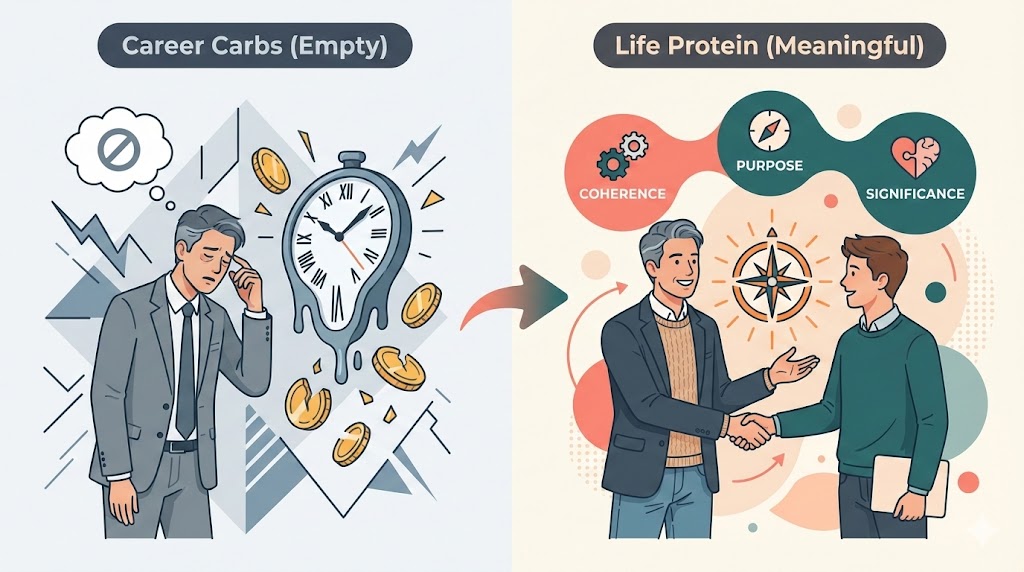
Imagine eating only bread and sugar for a year. You might have energy spikes (promotions, bonuses), but your muscles would atrophy, and your immune system would collapse. Attia’s analogy is precise: Pleasure and satisfaction are the carbohydrates and fats of life. They are necessary, but you can survive on varying ratios of them. Meaning, however, is protein. Without it, you die—spiritually first, and often physically later.
1.1 The Data of Despair
This is not poetic exaggeration; it is a measurable economic reality. The Gallup Global Workplace Report 2025 reveals a startling statistic: global employee engagement has dropped to 21%. This means nearly 80% of the workforce is merely showing up, consuming “carbs” (salary) without getting any “protein” (purpose). The crisis is most acute among middle managers, whose engagement plummeted from 30% to 27%. These are the people who have “made it,” yet they are the ones starving.
1.2 The “Empty Calorie” Trap
We often confuse happiness with meaning. Happiness is fleeting; it is a good dinner or a vacation. Meaning is resilient; it is the ability to endure suffering because you know why you are doing it. When you lack meaning, you try to compensate by overconsuming pleasure—more scrolling, more shopping, more luxury. But just as eating more candy won’t fix a protein deficiency, no amount of comfort will fix a meaning crisis.
| Metric | The “Carb” Life (Pleasure-Focused) | The “Protein” Life (Meaning-Focused) | Impact on Resilience |
|---|---|---|---|
| Primary Goal | Avoid pain, seek comfort | Pursue value, accept challenge | Meaning-focused individuals recover 2x faster from setbacks. |
| Work View | Transaction (Time for Money) | Contribution (Effort for Impact) | Transactional workers suffer higher burnout rates. |
| Crisis Response | “Why is this happening to me?” | “What can I learn from this?” | High “Protein” equals lower cortisol levels during stress. |
2. The Anatomy of Meaning: Coherence, Purpose, Significance
If meaning is protein, what are its amino acids? Philosophers and data scientists agree on three specific components. If you are feeling lost, you are likely deficient in one of these three.
2.1 Coherence: The Story Must Make Sense
Coherence is the feeling that your life’s events align into a logical narrative. It doesn’t mean everything is “good,” but that it is not random chaos. For many, the modern workplace destroys coherence. Projects get cancelled, strategies pivot aimlessly, and your hard work evaporates. When you cannot connect today’s effort to a larger picture, you lose coherence.
2.2 Purpose: The Direction
This is your “North Star.” In maritime terms, it’s the rhumb line—the course you are steering. It is not about reaching the destination tomorrow; it is about knowing you are heading the right way. A 2025 OECD report on social connections highlighted that individuals without a clear sense of purpose (direction) reported 40% higher levels of social anxiety. They don’t just feel lost; they feel unsafe.
3. The Midlife Shift: Surviving the “Vanaprastha” Era
In Vedic philosophy, life is divided into four quarters. The transition from the second quarter (Householder: building career and family) to the third quarter is called Vanaprastha—literally “retiring into the forest.”
3.1 The Economic Necessity of the Shift
Historically, you retired, rested, and died. Today, thanks to the Longevity Economy—now projected to reach $8.5 trillion by 2032—you might live another 30 or 40 years after your primary career peaks. This is not a vacation; it is a second life. The crisis happens when you try to apply “Householder” metrics (money, status, hustle) to the “Forest” phase. It doesn’t work. You are using an outdated operating system for new hardware.
3.2 The Manager’s Dilemma
This shift typically hits around age 50. You realize that climbing higher on the corporate ladder yields diminishing returns in satisfaction. The data supports this: income correlates with happiness only up to a point, after which the correlation flattens. If you don’t pivot to seeking significance over success, you enter a period of stagnation.
| Life Stage | Focus Metric | Common Trap | The Strategic Pivot |
|---|---|---|---|
| Phase 1: Householder (25-50) | Accumulation (Assets, Skills) | Burnout, Neglect of Relationships | Build competence, but don’t tie identity solely to titles. |
| Transition: The Gap (50-55) | Comparison (Am I ahead?) | Midlife Crisis, Empty Consumption | Acknowledge the shift. Stop competing; start mentoring. |
| Phase 2: Vanaprastha (55+) | Distribution (Wisdom, Legacy) | Irrelevance, Isolation | Move from “How do I win?” to “How do I help others win?” |
4. The Solution: How to “Get Small” to Live Big
So, how do you inject protein into your life? The counter-intuitive answer from the latest neuroscience is to make yourself feel smaller.
4.1 The Science of Awe
Dr. Dacher Keltner’s research on “Awe” provides a biological hack. When you experience awe—looking at a sunset, watching a master craftsman, seeing an act of kindness—your brain quiets the Default Mode Network (DMN), the part responsible for self-obsession and rumination. Furthermore, levels of Interleukin-6 (IL-6), a marker of inflammation, drop. You don’t need a meditation retreat; you need to witness things bigger than yourself.
4.2 Two Questions to Answer Today
To diagnose your current state, Peter Attia suggests a brutal but necessary two-question quiz. Do not give the “HR-approved” answer. Write down the real one.
1. Why are you alive?
If your answer is “to make VP” or “to pay the mortgage,” you are biologically alive but spiritually malnourished. You need an answer that speaks to your function in the humanity web.
2. For what are you willing to die today?
This clarifies what you actually love. If the answer is “nothing,” or you hesitate, it indicates you haven’t found your Significance yet.
4.3 Practical “Protein” Loading
You don’t quit your job tomorrow. You start micro-dosing meaning.
| Action | Why It Works | Immediate Step |
|---|---|---|
| The Awe Walk | Reduces self-focus (DMN activity) | Leave your phone. Walk for 15 mins. Look up at roofs/trees, not down at pavement. |
| The Mentor Shift | Creates Significance | Find a junior colleague. Offer help without expecting credit. This is pure “protein.” |
| The Legacy Audit | Restores Coherence | Write down 3 hard things you survived. Connect them to who you are today. |
References
- Global Wellness Institute, The Global Wellness Economy Monitor 2025, 2025.
- Gallup, State of the Global Workplace: 2025 Report, 2025.
- OECD, How’s Life? 2025: Measuring Social Connections, 2025.
- Aranca, The Future of the Longevity Economy, 2025.
Disclaimer
This article is for informational purposes only and does not constitute medical or psychological advice. If you are experiencing symptoms of depression or severe anxiety, please consult a qualified mental health professional.