It is 2 PM on a Tuesday. You have been staring at the same report for twenty minutes, your cursor blinking like a taunt. You are capable, experienced, and hardworking, yet you feel a distinct mental friction—as if your brain is wading through drying concrete. This isn’t just burnout; it is “cognitive rigidity.” In early 2026, the World Economic Forum highlighted “Curiosity and Lifelong Learning” as critical survival skills for the AI era, yet most professionals are operating with a brain chemistry locked in survival mode. We often dismiss “play” as a luxury for children or the retired, but neurobiology tells a different story. Based on insights from the Huberman Lab and the latest 2025 mental health data, we now know that play is the specific biological trigger for neuroplasticity. If you want to rewire your brain for the next chapter of your career or life, you don’t need more grit; you need to relearn how to play.
1. The Biological Cost of a “High-Stakes” Life
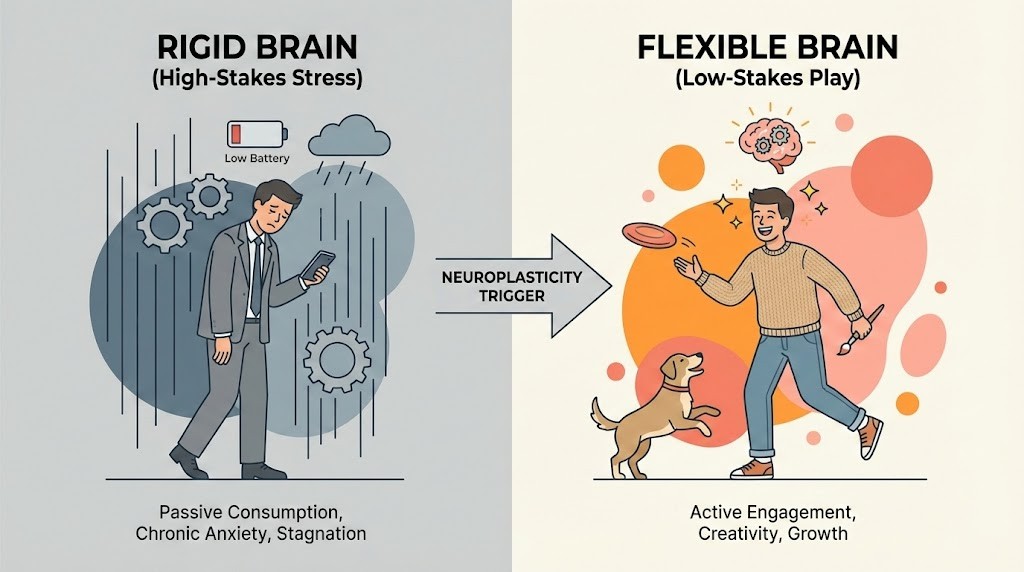
Modern adulthood is defined by “outcome dependence.” From the moment we wake up, every action has a consequence. We exercise to manage weight, we read to acquire skills, and we network to gain leverage. In neurobiological terms, this keeps our system flooded with adrenaline and cortisol. While effective for short-term execution, this chemical cocktail is toxic for learning.
1.1 The Paralysis of Efficiency
When every action requires a specific, successful outcome, the brain narrows its focus. This is the “survival mode.” While useful for escaping a predator or meeting a tight deadline, it shuts down the brain’s exploratory circuits. A 2025 study on workplace productivity revealed that professionals who engaged in zero non-outcome-based activities (pure hobbies) showed a 40% faster decline in creative problem-solving skills compared to those who maintained “useless” hobbies.
1.2 The “Low-Stakes” Requirement
Andrew Huberman emphasizes that neuroplasticity—the brain’s ability to change and upgrade itself—is most accessible under “low-stakes” conditions. This means engaging in activities where the outcome simply does not matter. If you fail, nothing happens. If you look silly, it has no impact on your salary. It is in this safety zone that the brain feels safe enough to release the chemical mixture required for rewiring. If you are constantly optimizing your life for efficiency, you are ironically making your brain less efficient at adapting to change.
| Neuro-State | High-Stakes Mode (Work/Survival) | Low-Stakes Mode (True Play) | Long-Term Impact |
|---|---|---|---|
| Primary Neurotransmitter | Adrenaline, Cortisol | Endogenous Opioids, BDNF | Stress vs. Growth |
| Brain Function | Execution of known habits | Exploration of new possibilities | Rigidity vs. Flexibility |
| Outcome Focus | 100% Outcome Dependent | Zero Outcome Dependence | Burnout vs. Renewal |
2. The Mechanics of Rewiring: PAG and Opioids
Let’s dive into the hardware. Why does “playing” feel different from merely “relaxing”? Relaxing might lower your heart rate, but it doesn’t necessarily rewire your brain. Play is an active state that engages a specific evolutionary machinery.
2.1 The Periaqueductal Gray (PAG)
Deep in the midbrain lies a structure called the Periaqueductal Gray (PAG). Huberman identifies this as a critical node for play behavior. When we engage in play—characterized by testing boundaries, role-playing, or light physical competition without intent to harm—the PAG lights up. This activation triggers the release of endogenous opioids. These aren’t just painkillers; they are chemical signals that tell the brain, “This creates social bonding, and it is safe to try new things here.”
2.2 Chemically Opening the Window
Think of your brain as clay. In high-stress adulthood, that clay is dry and hard. You can chip away at it, but you cannot reshape it. The opioids released during play act like water, softening the clay. Once the brain is in this pliable state, the prefrontal cortex—the CEO of your brain—can evaluate new strategies, simulate different futures, and update old beliefs. Without this chemical softening, trying to learn a new skill or adapt to a post-retirement identity is an uphill battle against your own biology.
3. Digital Consumption vs. Real Play
Here lies the biggest trap for the modern individual. We confuse “dopamine hits” with “play.” Scrolling through TikTok, watching Netflix, or playing a repetitive mobile game designed to monetize your attention is not play. It is passive consumption.
3.1 The Dopamine Trap
Passive digital consumption spikes dopamine but lacks the unpredictability and physical engagement required to activate the PAG. It is a sterile experience. Your brain knows you are not moving, and it knows the outcome is pre-programmed algorithmically. Therefore, no opioids are released, and no plasticity occurs. You end up over-stimulated yet under-fulfilled, leading to the phenomenon known as “Popcorn Brain”—where focus is scattered, and deep thinking becomes impossible.
3.2 The Return to Analog (2026 Trend)
This explains the massive surge in “Analog Wellness” we are seeing in 2026. From the revival of adult intramural sports leagues to the explosion of tabletop gaming cafes and vinyl listening bars, people are instinctively seeking three-dimensional, unpredictable interactions. True play requires presence. It often involves movement, eye contact, and the subtle reading of social cues—all of which are absent in the digital realm.
| Activity Type | Description | PAG Activation | Brain Plasticity Effect |
|---|---|---|---|
| Passive Consumption | Social Media, TV, Algorithm feeds | None (Low) | Negative (Cognitive Decline) |
| Structured Leisure | Gym workout, Planned reading | Low to Medium | Maintenance (Keeps current state) |
| True Play | Improv, Team Sports, Creative Hobbies | High (Opioid Release) | High (Rewiring & Growth) |
4. Strategic Implementation for Adults
So, how do we reintegrate play without quitting our jobs or acting irresponsibly? The goal is not to become childish, but to become “playful” in a strategic sense. We need to micro-dose low-stakes environments into our high-stakes lives.
4.1 The “2-Hour” Rule
Aim for at least two hours a week of pure, low-stakes activity. The criteria are strict: it must not be something you can put on a resume, and it must not have a financial metric attached. This could be sketching (badly), tossing a frisbee with a dog, or dancing in your living room. The key is to detach from the result. If you are trying to “get good” at it, you have turned it into work. Keep it amateur. Keep it messy.
4.2 Social Play and Connection
The WHO’s Commission on Social Connection (2024-2026) has repeatedly flagged isolation as a top mortality risk. Play is the antidote. When we play with others, we signal safety and trust more effectively than any conversation could. For retirees, this is crucial. Replacing the hierarchy of the workplace with the egalitarian dynamics of a hobby group can prevent the rapid cognitive decline often seen after retirement.
| Strategy | Current Habit (High Stakes) | Proposed Shift (Low Stakes) | Expected Benefit |
|---|---|---|---|
| Physical | Timed run for cardio efficiency | Unstructured hiking or ball games | Proprioceptive variability & agility |
| Mental | Reading industry news | Reading fiction or solving puzzles | Expanded empathy & pattern recognition |
| Social | Networking events | Board game nights or casual meetups | Deep oxytocin bonding & trust |
References
- Huberman Lab, “Using Play to Rewire & Improve Your Brain”, 2024.
- World Health Organization (WHO), “Commission on Social Connection Report”, 2025.
- World Economic Forum (WEF), “The Future of Jobs Report”, 2025.
- Global Wellness Institute, “The Future of Wellness 2025 Trends”, 2025.
Disclaimer
This content is for informational purposes only and does not constitute medical advice or professional diagnosis. Always consult with a healthcare provider or mental health professional regarding specific medical conditions or changes to your lifestyle.