
It is February 2026, and the global markets are shifting. You might be a software engineer in California or a business owner in London, watching the US tech stocks plateau while hearing aggressive growth stories from the East. Just days ago, Larry Fink of BlackRock and Mukesh Ambani of Reliance met in Mumbai to launch their joint venture, declaring this the “Era of India” for the next 25 years. But as a pragmatic investor, you know that grand declarations often signal market tops. Is this real structural growth, or just a sales pitch? This analysis cuts through the hype, verifies the numbers, and explores whether it is too late—or just the beginning—to allocate capital to India.
1. Fact-Checking the “Era of India” Claims
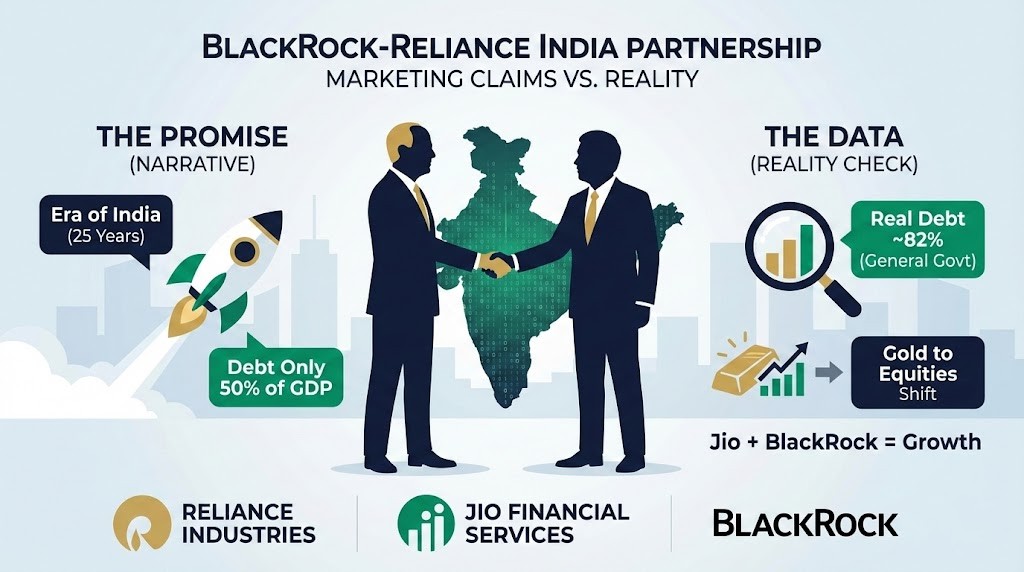
When two of the world’s most powerful capital allocators stand on a stage and declare a 25-year bull run, skepticism is the healthy first response. Larry Fink and Mukesh Ambani argued that India’s growth is not just a quarterly event but a generational shift. However, we must look at the specific data points they used to justify this optimism, particularly regarding debt and demographics.
1.1 The “50% Debt” Narrative vs. Reality
Mukesh Ambani highlighted that India’s government debt is around 50% of GDP, contrasting it favorably with the global norm of 100%. This statement requires nuance. While the Central Government Debt might be near that figure, when we include state-level debt (General Government Debt), the figure is closer to 81-82% (IMF estimates for 2025-26). While this is still manageable compared to the US or Japan, it is not as pristine as the “50%” soundbite suggests. Investors should interpret this not as “risk-free” but as “stable enough to support growth.”
1.2 The Demographic Dividend
The core of the bullish argument remains valid: India is home to 20% of the world’s population but only accounts for a fraction of global financial assets. The median age is still under 30. This creates a natural floor for consumption growth. However, a large population is only a dividend if they have jobs. The real metric to watch is not population size, but the formalization of the economy—how many of these people are entering the tax and banking system.
| Key Metric | The “Marketing” View | The Real Data (2026) | Investor Implication |
|---|---|---|---|
| Govt Debt/GDP | “Only 50%” | ~81.9% (General Govt) | Stable, but watch fiscal deficits. |
| Demographics | “Youngest Workforce” | High Youth Unemployment | Growth will be uneven; focus on leaders. |
| Market Trend | “25-Year Bull Run” | High Valuations (PER 24x+) | Expect volatility; buy on dips. |
2. The Great Shift: From Gold to Equities
The most significant opportunity for foreign investors lies in a domestic behavioral change. For generations, Indian households have stored wealth in physical gold and real estate. This “dead capital” is now moving into the stock market at an unprecedented rate, driven by digitization and platforms like the new Jio-BlackRock venture.
2.1 The Financialization of Savings
Imagine trillions of dollars locked in gold jewelry suddenly flowing into index funds. This is the thesis behind Jio Financial Services (JIOFIN). By combining BlackRock’s investment expertise with Reliance’s massive user base (Jio), they aim to democratize investing for the average Indian. This is not just about selling mutual funds; it is about converting savers into investors. If they capture even 10% of the annual gold demand into financial products, the AUM (Assets Under Management) growth will be exponential.
2.2 Digital Infrastructure as a Moat
India’s digital stack (UPI for payments, Aadhaar for identity) allows financial companies to onboard customers at near-zero cost. This gives incumbents a massive advantage. While Western fintechs struggle with high customer acquisition costs, Indian players can scale rapidly. This structural efficiency is why the “premium” valuations of Indian financial stocks are often justified.
3. Deep Dive: Reliance Industries & Jio Financial
To play this theme, we look at the two giants at the center of the news: Reliance Industries (the parent) and Jio Financial Services (the fintech spin-off).
3.1 Reliance Industries (RELIANCE.NS)
Reliance is often called the “proxy for India.” It is no longer just an oil refiner; it is a retail, telecom, and green energy giant. Currently trading around ₹1,456 (post-bonus issue adjustment), the stock is trading at a PER of roughly 40x. This is expensive by traditional oil major standards but reasonable for a tech-to-consumer conglomerate. The “Bull Case” is that their New Energy business becomes profitable by 2027. The “Bear Case” is that their heavy capex spending drags down free cash flow for longer than expected.
3.2 Jio Financial Services (JIOFIN.NS)
Trading at ₹268, Jio Financial is the high-beta play. With a PER exceeding 100x, it is priced for perfection. The market is pricing in the success of the BlackRock partnership before it has fully materialized. For a conservative investor, this is a risky entry point. However, for those with a 10-year horizon, JIOFIN represents the “Visa + BlackRock” of India. The strategy here is not to go “all in” but to accumulate shares slowly during market corrections.
| Company | Current Price (INR) | Valuation Status | Strategic Verdict |
|---|---|---|---|
| Reliance Ind. | ₹1,456 | Fairly Valued | Core holding. Safe proxy for India growth. |
| Jio Financial | ₹268 | Premium/Expensive | High risk/reward. Buy only on pullbacks. |
4. Strategic Allocation for Global Investors
You do not need to open a brokerage account in Mumbai to participate. For most global investors, ETFs offer a liquid and efficient way to gain exposure while mitigating single-stock risk.
4.1 The Easy Route: ETFs
The iShares MSCI India ETF (INDA) is the standard vehicle for US-based investors. It holds Reliance, Infosys, and major banks. It provides broad exposure to the “formal economy.” However, be aware of the expense ratio (~0.64%). For investors looking for more aggressive growth, look for ETFs that focus on the “Nifty Next 50” or mid-cap sectors, as these companies often outperform the giants during expansionary cycles.
4.2 Portfolio Sizing and Risk
India is a high-growth market, but it is also volatile. It should not replace your core US or global exposure. A sensible allocation might be 5-10% of your equity portfolio, depending on your risk tolerance. Treat this as a satellite position—one that you plan to hold for the promised “25-year era,” not something to trade for a quick profit next week.
References
- Bloomberg TV, “BlackRock’s Fink, Reliance’s Ambani Hail ‘Era Of India'”, 2026.
- IMF, “World Economic Outlook Update: India’s Growth Trajectory”, 2025.
- National Stock Exchange of India (NSE), Real-time Market Data (RELIANCE, JIOFIN), Feb 5, 2026.
Disclaimer
This content is for informational purposes only and does not constitute financial advice, an offer to sell, or a solicitation of an offer to buy any securities. All investments involve risk, including the loss of principal. Please consult with a qualified financial advisor before making any investment decisions. The author has no position in the securities mentioned.