
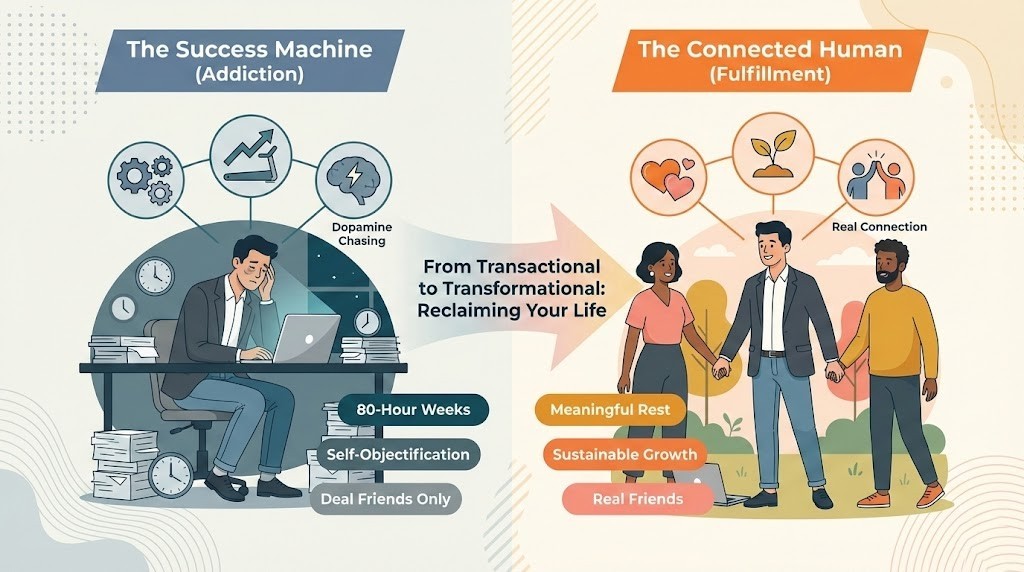
It is 11:30 PM on a Tuesday. You are sitting in a darkened living room, the blue light of your laptop reflecting off your tired eyes. You told your partner you would be done two hours ago, but you found yourself scrolling through old spreadsheets, looking for one more ‘win’ before bed. You are not alone. According to the 2024 Global Workplace Report, nearly 60% of professionals in major financial and tech hubs feel physically unable to disconnect, even when they are technically off the clock. This is not just about a heavy workload or a demanding boss. It is a profound psychological shift where we have begun to see ourselves as success machines rather than human beings. The constant drive for the next promotion, the next big deal, or the next public accolade has created a generation of ‘strivers’ who are physically present at the dinner table but emotionally absent from their own lives. We need to talk about why this is happening and why the solution is not just ‘taking a vacation.’
1. The Biological Root of Professional Overdrive
Most people believe they work long hours because they are ambitious or because the market demands it. However, the reality is often internal and chemical. We have become addicted to the neurochemical rewards of achievement. Every time we close a deal, receive a compliment from a superior, or hit a KPI target, our brain releases dopamine. This is the same chemical involved in substance addiction. This creates a cycle where we seek increasingly larger ‘wins’ to feel the same level of satisfaction.
1.1 Understanding the Dopamine Loop in Career Growth
Dopamine is a neuromodulator that drives us to seek rewards. In the workplace, this manifests as a constant need for validation. We are not just working for the paycheck anymore; we are working for the psychological ‘hit’ of being special. This cycle is dangerous because dopamine is about the *pursuit* of the reward, not the satisfaction of having it. This explains why, ten minutes after a major promotion, many strivers already feel empty and start looking for the next hurdle. The joy is fleeting, but the exhaustion is permanent.
1.2 The Difference Between Healthy Ambition and Addiction
It is crucial to distinguish between wanting to do good work and being addicted to success. Healthy ambition is about creating value and finding meaning. Success addiction is about fear—the fear that if you stop achieving, you cease to exist. When your self-worth is entirely tethered to your output, you become a prisoner of your own resume.
| Feature | Healthy Ambition | Success Addiction | Impact on Life |
|---|---|---|---|
| Primary Driver | Internal desire to create value | External need for validation | Addicts feel empty without praise |
| Reaction to Failure | Disappointment, then learning | Devastating loss of self-worth | Addicts hide failures, increasing stress |
| Relationship to Time | Views rest as necessary for fuel | Views rest as a waste of time | Chronic burnout and health issues |
2. The High Cost of Self-Objectification at Work
When we prioritize success above all else, we commit a subtle act of violence against ourselves: self-objectification. We start treating ourselves like machines designed to produce output. If you are a machine, your value is binary. You are either working (valuable) or you are broken (useless). This mindset explains why so many high-performers feel guilty when they are simply watching a movie or playing with their children.
2.1 The Danger of Being Special Instead of Happy
Many of us trade happiness for ‘specialness.’ We want to be the one who can handle the impossible workload. We want to be the martyr who sends emails at 2 AM. But this desire to be special isolates us. It creates a wall between us and the people who love us, because intimacy requires vulnerability, and machines are not vulnerable. Your family does not need you to be a success machine; they need you to be a human being.
2.2 Deal Friends vs. Real Friends
In his research on happiness and work, social scientist Arthur Brooks identifies a critical distinction in the relationships of successful people: ‘Deal Friends’ versus ‘Real Friends.’ Deal friends are transactional; they are useful to you, and you are useful to them. Real friends are, in the most beautiful sense, useless. They do not need anything from you professionally. If you lost your job tomorrow, your deal friends would drift away, but your real friends would come over with pizza. The problem is that as we become addicted to success, we neglect our real friends and fill our lives with deal friends.
| Relationship Type | Basis of Connection | Reaction to Your Success | Reaction to Your Failure |
|---|---|---|---|
| Deal Friends | Transaction / Utility | Envy or Calculation | Disappearance / Distance |
| Real Friends | Affection / Shared History | Genuine Celebration | Support and Comfort |
| Action Required | Maintain boundaries | Prioritize time (Schedule it) | Invest emotional energy here |
3. Redefining High Performance Through Human Connection
The antidote to workaholism is not just ‘working less.’ If you simply stop working without filling the void, you will feel anxious and purposeless. The true substitute for the dopamine of success is the oxytocin of connection. Love and deep human connection are the only things powerful enough to break the addiction to achievement.
3.1 The 14th Hour Principle
Think about your energy distribution. Many professionals give their absolute best energy—their ‘first 12 hours’—to their employer and clients. Then, they give the ’14th hour’—the scraps of their energy, their exhaustion, and their irritability—to their spouse and children. This is a strategic error. Your career cannot love you back. When you retire or if you get sick, your company will replace you within weeks. Your family and true friends are the only ones who will remember your presence.
3.2 Spiritual and Philosophical Grounding
You do not need to be religious to have a spiritual practice. This is about connecting to something larger than your quarterly targets. Whether it is reading Stoic philosophy, engaging in meditation, or appreciating art and nature, you need a source of meaning that is not derived from capitalism. This ‘metaphysical’ grounding provides a buffer against the ups and downs of the market.
4. Practical Steps to Reclaim Your Human Identity
Recovery from success addiction requires a systematic approach. You cannot simply wish it away. You must build a new infrastructure for your life that makes workaholism less convenient and connection more accessible.
4.1 Audit Your Inner Circle
Look at the five people you spend the most time with. How many are ‘Deal Friends’ and how many are ‘Real Friends’? If the answer is mostly deal friends, you are in a high-risk category for burnout. Make a conscious effort this week to reach out to one person who has no connection to your industry. Call them. Do not text. Ask them how they are doing and listen without checking your email.
4.2 The Schedule Defense Strategy
We schedule meetings with clients months in advance, but we leave our personal lives to chance. This must change. Block out time for ‘useless’ activities—hobbies that have no ROI (Return on Investment), time with friends, or just sitting in a park. Treat these blocks with the same sanctity as a board meeting. If someone asks for that time, the answer is, ‘I have a prior commitment.’ You do not need to explain that the commitment is with yourself.
| Strategy | Current Behavior | New Behavior | Expected Outcome |
|---|---|---|---|
| Digital Boundary | Phone in bedroom / Check email in bathroom | Phone charges in kitchen overnight | Better sleep / Mental separation |
| Social Investment | Networking events only | Monthly dinner with non-work friends | Restored sense of belonging |
| Identity Check | “I am a [Job Title]” | “I am a person who enjoys [Hobby/Value]” | Resilience against career setbacks |
References
- Harvard Business Review, “Fighting Workaholism: You Are Not a Success Machine” (Video), 2024.
- OECD (Organization for Economic Cooperation and Development), “Employment Outlook 2024: The Worker’s Perspective”, 2024.
- Global Workplace Analytics, “State of the Global Workplace: 2024 Report”, 2024.
Disclaimer
This article is for informational purposes only and does not constitute medical or psychological advice. If you are experiencing symptoms of severe burnout, depression, or anxiety, please consult with a qualified mental health professional.