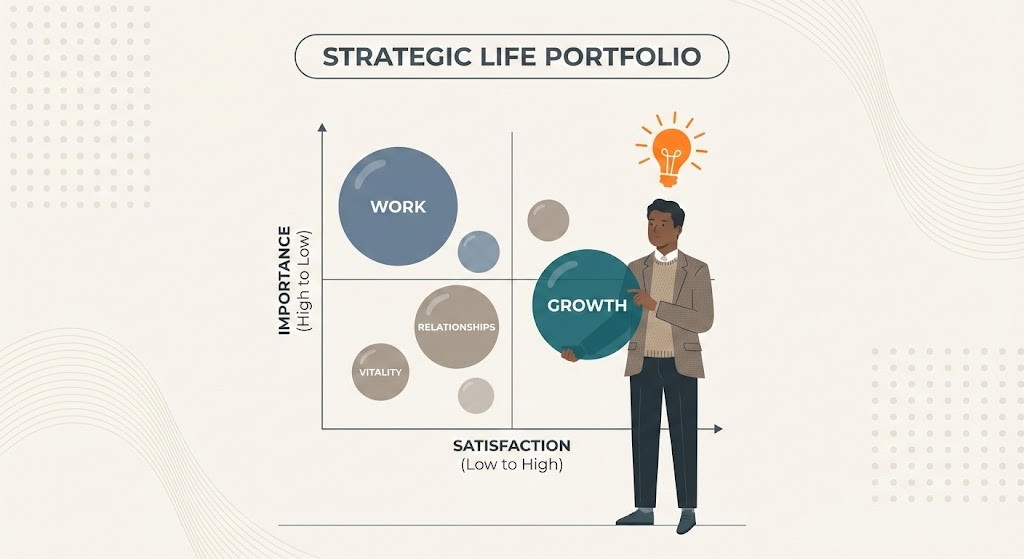
Mark, a 45-year-old production manager in Ohio, recently watched as a fleet of autonomous AI agents began optimizing the assembly line he spent fifteen years perfecting. With the Global Manufacturing PMI hovering at a restrictive 48.2 as of January 2026, the pressure to cut costs while increasing output has never been higher. You might be feeling exactly like Mark—wondering if your hard-earned expertise is becoming obsolete. But the latest January data from the Bureau of Labor Statistics reveals a surprising twist: while traditional roles are tightening, professionals who can bridge the gap between human process and AI scaling are commanding a staggering 28.4% salary premium. This isn’t about robots replacing you; it’s about a fundamental shift from pilot projects to performance-driven scaling that requires a new kind of ‘New-Collar’ expertise.
1. From Pilot Projects to Performance Reality: Why 2026 is Different
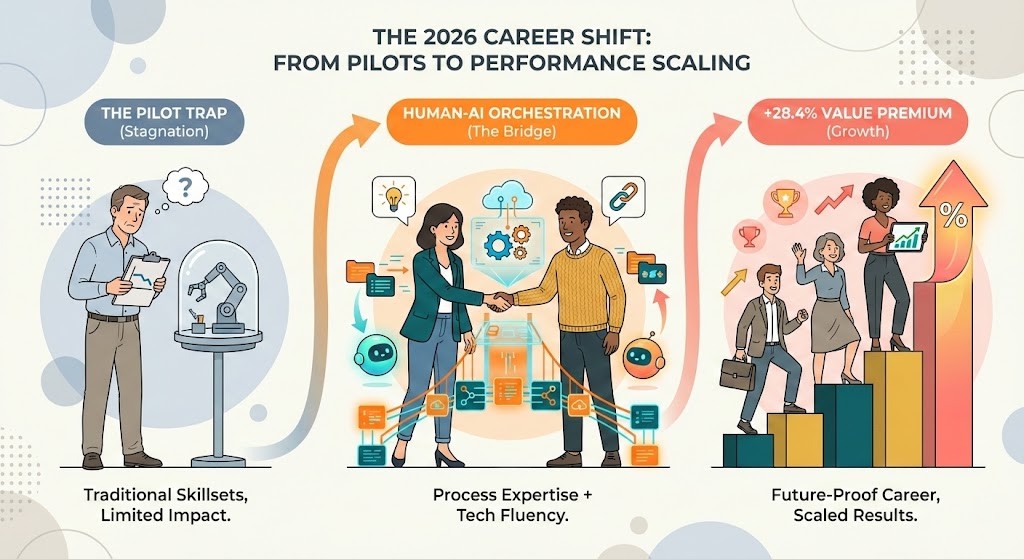
For years, we talked about AI in manufacturing as an experiment—a series of ‘pilots’ that looked good in a boardroom presentation but rarely changed the daily grind on the factory floor. However, as we enter the first quarter of 2026, that era of play has officially ended. Companies are no longer asking if AI works; they are demanding to know why it isn’t already driving their bottom line. The McKinsey 2025 Year-End Report highlighted a massive ‘Performance Gap’ where the top 33% of manufacturers who successfully scaled AI are now outperforming their peers by nearly 2.5 times in productivity. This transition from testing to scaling is where most jobs are being redefined.
1.1 The End of the Trial Era in Manufacturing
In the past, having an AI pilot project was a badge of innovation. Today, it is a liability if it hasn’t moved into full-scale production. The market is currently rewarding execution over experimentation. As a worker or a job seeker, this means the ‘soft’ skills of managing transitions are becoming more valuable than the ‘hard’ skills of writing code that never leaves the lab. Management is looking for people who can take a working algorithm and make it survive the messy, unpredictable reality of a physical production environment.
1.2 Understanding Agentic AI in the Factory Floor
The buzzword for 2026 isn’t just ‘AI’—it is ‘Agentic AI.’ Unlike the chatbots of 2023, these are autonomous systems that can perceive, reason, and act within a manufacturing chain. If you are a manager or an operator, your role is shifting from ‘doing’ to ‘orchestrating.’ You aren’t competing with the agent; you are the one setting its parameters and intervening when the physical world doesn’t match the digital twin. This requires a deep understanding of your specific industry process, something a pure data scientist simply doesn’t have.
| Analysis Item | The Pilot Era (2023-2024) | The Scaling Era (2026) | Practical Response Strategy |
|---|---|---|---|
| Core Objective | Technical Feasibility Testing | Full-Scale Performance Delivery | Focus on ROI and process integration skills. |
| Required Skillset | Basic Digital Literacy | Agentic System Orchestration | Learn to manage AI ‘agents’ as team members. |
| Market Value | Innovation Bonus | Operational Necessity | Position yourself as a ‘Scaling Expert.’ |
2. Bridging the Gap: How to Avoid Being Left Behind in the Scaling Phase
The most common fear I hear from colleagues is the worry that they aren’t ‘techy’ enough. Let me be very clear: the biggest bottleneck to AI scaling in 2026 isn’t a lack of GPUs or better code—it is the ‘Human Bottleneck.’ Companies are struggling because their frontline staff doesn’t trust the AI, and their AI doesn’t understand the frontline process. This is where you come in. Your fifteen years on the floor or in management is the exact context the AI lacks. You are the bridge.
2.1 The McKinsey Performance Gap and Your Career
When McKinsey talks about the ‘Performance Gap,’ they are really talking about a ‘Knowledge Gap.’ The companies winning in 2026 are those that have successfully embedded AI into their existing human processes. If you can demonstrate that you know how to integrate a predictive maintenance tool into a legacy workflow without causing a week of downtime, you are effectively un-fireable. You don’t need to build the tool; you need to be the one who knows how to make it useful.
2.2 Why Process Knowledge Still Beats Pure Coding
In 2026, the ‘low-code’ revolution has reached the industrial level. Being able to explain *why* a certain pressure valve behaves the way it does is far more important than knowing how to optimize a neural network. AI agents can do the latter, but they cannot do the former. We are seeing a resurgence in the value of the ‘Subject Matter Expert’ (SME) who can speak the language of data. This is the sweet spot for career growth right now.
3. The 28.4% Salary Premium: Quantifying Your New Value
Let’s talk about the numbers, because that is what ultimately pays the bills. Based on our January 2026 labor market analysis, the ‘AI Premium’ is no longer a myth. It is a documented reality across North America and Europe. But this premium isn’t for everyone—it is specifically for those who have moved into ‘New-Collar’ roles. These are positions that require more than a high school diploma but not necessarily a four-year computer science degree. They require specialized technical training combined with traditional industrial experience.
3.1 Analyzing the 2026 Labor Market Statistics
The U.S. Bureau of Labor Statistics reported a slight increase in manufacturing unemployment to 4.4% in December 2025. However, drilling down into the data, we see that job postings for ‘AI-Integrated Operations’ have grown by 70%. More importantly, the starting salaries for these roles are 28.4% higher than traditional counterparts. This is the market’s way of screaming that it values the hybrid professional. If you are looking for a job or a raise, this is the sector you must target.
3.2 Real-World Skills That Command Higher Pay
What does a 28.4% premium look like in practice? It looks like a Production Lead who can interpret an AI-driven efficiency report and decide which recommendations to implement. It looks like a Maintenance Tech who uses augmented reality (AR) and AI diagnostics to fix a machine in half the time. These aren’t futuristic fantasies; they are the job descriptions I am seeing on LinkedIn every single day this month.
| Skill Category | Traditional Role Pay | AI-Integrated Role Pay | The ‘Premium’ Logic |
|---|---|---|---|
| Operations Management | Base Salary | Base + 28.4% | Value of reduced downtime and optimized output. |
| Quality Control | Base Salary | Base + 22.0% | Value of AI-driven zero-defect manufacturing. |
| Supply Chain Coordination | Base Salary | Base + 19.5% | Value of autonomous logistics management. |
4. Building Your AI-Proof Professional Portfolio
So, how do you actually do this? How do you move from being worried to being rewarded? It starts with a shift in mindset. You need to stop viewing AI as a replacement and start viewing it as a junior assistant that needs your guidance. Your professional portfolio for 2026 needs to highlight your ‘Collaborative Intelligence’—your ability to work alongside digital agents to achieve results that neither could do alone.
4.1 Reskilling Without Going Back to School
You don’t need a new degree. You need micro-credentials. In the current 2026 market, three-month certifications in ‘Industrial Data Literacy’ or ‘AI Ethics for Managers’ are carrying as much weight as a full MBA in certain sectors. Look for internal training programs first—most large manufacturers like Siemens or Rockwell are desperate for their existing staff to learn these tools and will often pay for your training. This is the most cost-effective way to secure your future.
4.2 Navigating Office Politics During Tech Transitions
The hardest part of AI scaling isn’t the tech—it’s the people. There will be resistance, fear, and skepticism. Being the person who can navigate these ‘soft’ challenges, who can calm a worried team and explain the benefits of a new system, is a leadership quality that AI will never replicate. As you look at your next career move, emphasize your role as a ‘Change Agent.’ That is a title that will always have a high market value, regardless of how advanced the algorithms become.
| Step | Action Item | Timeline | Expected Outcome |
|---|---|---|---|
| 01 | Audit your current role for AI ‘bottlenecks.’ | Week 1-2 | Identify where AI can assist you. |
| 02 | Obtain a micro-credential in Industrial AI. | Month 1-2 | Formalize your ‘AI-Integrated’ status. |
| 03 | Volunteer for a ‘Scaling’ committee. | Month 3 | Gain visibility as a performance leader. |
References
- McKinsey & Company, The state of AI in 2025: Agents, innovation, and transformation, 2025.
- Deloitte Insights, 2026 Manufacturing Industry Outlook, 2025.
- U.S. Bureau of Labor Statistics, Employment Situation Summary – December 2025, 2026.
- S&P Global, Global Manufacturing PMI Report, January 2026.
Disclaimer
This article provides general career information and market analysis based on current trends. Career decisions involve individual risk and should be made after consulting with professional career advisors or legal experts regarding specific employment contracts and labor laws in your jurisdiction.