Imagine being 45 years old and realizing that your 62-year-old manager has more cognitive stamina and physical energy than you do. In January 2026, this is not a rare occurrence but a reflection of the burgeoning Longevity Economy. As Bloomberg Intelligence recently reported, the precision wellness market has hit a staggering $31.6 billion this month, shifting the focus from living longer to living younger. For office workers, retirees, and job seekers alike, your biological age has effectively become your new credit score, determining your productivity and professional longevity in an AI-driven world. This is not about vanity; it is about maintaining your competitive edge when the traditional retirement age is being redefined by biological capability rather than years on a calendar.
1. The Shift to Biological Age as Professional Capital
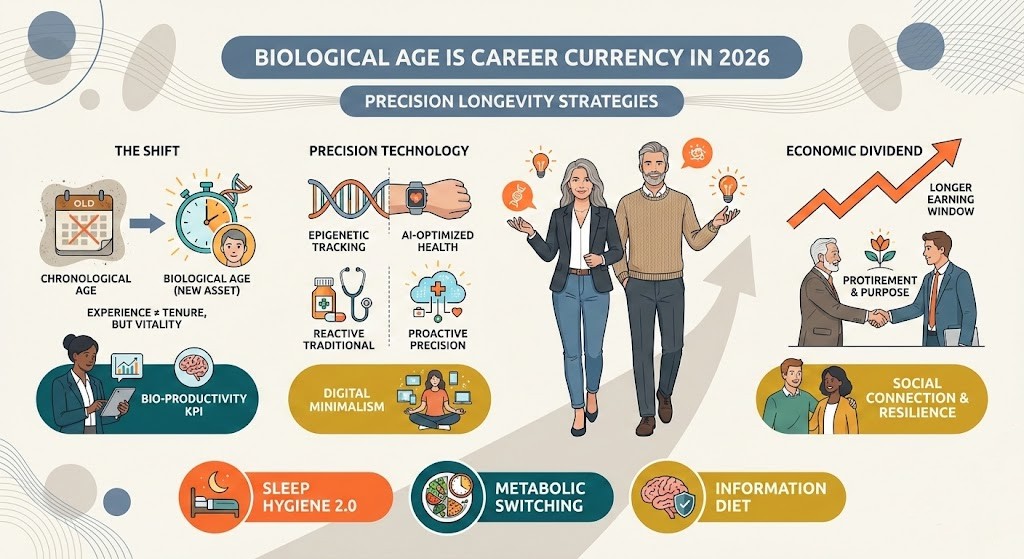
In the current 2026 labor market, the definition of experience is undergoing a radical transformation. We are seeing a divergence where chronological age is losing its relevance, replaced by a metric known as biological age—the actual functional state of your cells and organs. For a professional, this means that your ability to adapt to new AI tools, maintain focus during long digital sprints, and recover from high-stress periods is now a measurable asset. The latest data from the OECD suggests that organizations are beginning to prioritize cognitive endurance over mere tenure. This shift means that a job seeker in their 50s who has invested in precision longevity protocols is often more attractive to recruiters than a burnt-out 30-something. The goal is no longer just to reach retirement but to remain at your peak performance level for decades longer than previously thought possible.
1.1 Understanding the Productivity Gap in 2026
The gap between those who actively manage their biological aging and those who do not is widening. This isn’t just about going to the gym; it is about the targeted use of epigenetic data to optimize daily performance. In early 2026, we are seeing ‘Bio-productivity’ emerge as a key performance indicator in high-stakes corporate environments. If you cannot maintain the cognitive load required by modern systems, you risk being sidelined, regardless of your past achievements. This is the harsh reality of the 2026 economy: your health is your wealth, quite literally.
1.2 The Role of AI in Personal Health Optimization
AI is no longer just for your spreadsheets; it is inside your wellness routine. By January 2026, AI-driven nutrition and supplement protocols based on real-time blood markers have become mainstream. These systems provide a level of precision that makes the ‘one-size-fits-all’ advice of the past look like ancient history. For the average worker, this means having a personalized roadmap that adjusts based on sleep quality, stress levels, and nutrient absorption, ensuring that your biological machinery is always running at its best.
| Analysis Element | Traditional Approach | 2026 Precision Model | Actionable Strategy |
|---|---|---|---|
| Health Monitoring | Annual physical exams | Real-time epigenetic tracking | Use wearable biosensors for daily data |
| Retirement Planning | Fixed age (65) | Functional capacity based | Invest in health as a career extension fund |
| Nutrition | Generic food pyramids | AI-optimized metabolic fueling | Test for nutrient deficiencies quarterly |
2. Precision Longevity versus Traditional Healthcare Models
The healthcare landscape of 2026 has bifurcated. On one side, we have the reactive model—treating illness after it occurs. On the other, we have Precision Longevity, which uses predictive analytics to slow down the aging process itself. McKinsey Health Institute’s 2026 report highlights that proactive wellness spending has overtaken reactive medical costs for the top 30% of earners. This shift is critical for anyone worried about the rising costs of healthcare in retirement. By investing in precision protocols now, you are essentially buying back years of healthy, productive life. It is the difference between spending your 70s in a clinic or spending them starting a second or third career. The technology to monitor telomere length and DNA methylation is now affordable enough for the middle class, making it the most significant financial hedge of our time.
2.1 The Rise of Epigenetic Testing
Epigenetic testing has moved from the lab to the living room. In 2026, you can determine your biological age with a simple at-home kit for under $150. This data allows you to see exactly how your lifestyle choices—diet, sleep, and even social interactions—are affecting your gene expression. It provides a feedback loop that was previously impossible. When you can see the direct impact of a stressful work week on your biological clock, you are much more likely to make the necessary adjustments to protect your longevity.
2.2 Digital Minimalism as a Biological Necessity
We have reached a tipping point where digital overconsumption is recognized as a major accelerant of biological aging. Constant connectivity leads to chronic cortisol elevation, which damages mitochondria—the powerhouses of your cells. In 2026, digital minimalism is not just a lifestyle choice; it is a clinical recommendation for those seeking to lower their biological age. High-performers are now scheduling ‘analog windows’ to allow their nervous systems to reset, recognizing that a focused mind is a younger mind.
| Metric | 2023 Baseline | 2026 Current Status | Implication for Readers |
|---|---|---|---|
| Longevity Market Size | $5.3 Trillion | $8.0 Trillion (Estimated) | Longevity is the primary economic driver |
| Bio-age Test Cost | $500+ | $149 and below | Accessibility allows for mass adoption |
| Workforce Participation 60+ | Low/Moderate | Significant (AI-supported) | Career spans are extending by 10-15 years |
3. Economic Implications of the Longevity Dividend in 2026
The ‘Longevity Dividend’ refers to the economic benefits gained from extending the healthy lifespan of the population. For you, the individual, this dividend manifests as a longer earning window and reduced late-life medical expenses. UBS Global Wealth Management notes that in 2026, the most successful portfolios are those that account for a 100-year life. This requires a fundamental shift in how we think about savings. If you are going to be biologically fit to work until 75, your asset allocation must reflect that. Conversely, the cost of ignoring longevity is higher than ever. With the weakening of traditional social safety nets, those who age prematurely will face a double burden: high medical costs and an inability to participate in the gig or consulting economy. The economic divide of 2026 is becoming a biological one.
3.1 The New Gig Economy for Retirees
Retirement is being replaced by ‘Protirement’—a phase where individuals use their decades of experience to consult, mentor, or start micro-businesses, supported by AI. However, this is only possible if your cognitive health remains intact. In 2026, we see a massive surge in senior entrepreneurs who are leveraging longevity protocols to outpace younger competitors. They have the wisdom of age and the vitality of youth, thanks to precision interventions.
3.2 Social Isolation and the Aging Process
One of the most overlooked factors in biological aging is social connection. Research in 2025 and 2026 has confirmed that chronic loneliness accelerates aging as much as smoking fifteen cigarettes a day. As we move further into a digital-first world, maintaining high-quality, in-person social networks is a critical component of any longevity plan. It is the ‘soft’ side of precision wellness that has ‘hard’ biological outcomes.
| Target Audience | Current Pain Point | 2026 Solution | Meaning for the Future |
|---|---|---|---|
| Office Workers | Burnout and brain fog | AI-driven metabolic tuning | Sustained high performance at any age |
| Retirees | Financial and health anxiety | Longevity-based financial planning | Financial security through extended vitality |
| Job Seekers | Ageism in hiring | Certified Biological Age metrics | Proof of competence beyond birth year |
4. Practical Frameworks for Reducing Biological Age Today
You do not need a billion-dollar laboratory to start reversing your biological age. In 2026, the most effective strategies are those that combine cutting-edge data with consistent, low-cost habits. Start by prioritizing ‘Sleep Hygiene 2.0’—using cooling technologies and light optimization to maximize cellular repair. Next, embrace intermittent metabolic switching; it is not just about weight loss, but about triggering autophagy, the body’s internal recycling system. Finally, manage your ‘Information Diet.’ In an age of AI-generated noise, protecting your mental clarity is essential for long-term brain health. These are not just wellness tips; they are the building blocks of your 2026 survival strategy. The goal is to build a body and mind that are resilient enough to handle the rapid changes of the mid-21st century.
4.1 Building Your Longevity Routine
A sustainable routine in 2026 focuses on the three pillars: Micro-movements, Macro-nutrition, and Mental Stillness. Incorporating short bursts of high-intensity activity throughout the day has been shown to be more effective for longevity than a single long gym session. Coupled with a diet high in polyphenols and low in ultra-processed foods, these habits create a biological environment where aging is slowed to a crawl. The key is consistency over intensity.
4.2 The Philosophy of a Longer Life
Finally, we must address the ‘Why.’ Living longer is only valuable if that life has purpose. In 2026, we are seeing a resurgence of philosophical inquiry among those who have achieved economic freedom. They are asking how to use their extra decades to contribute to society. Whether it is through volunteering, creative pursuits, or lifelong learning, having a clear sense of purpose is perhaps the most powerful longevity tool we have. It provides the psychological resilience needed to navigate the complexities of modern life.
References
- UBS Global Wealth Management, Daily: Investing in Longevity, 2025.
- Mordor Intelligence, Longevity Market Share & Size Growth Outlook to 2031, 2026.
- McKinsey Health Institute, Health & Wellness Predictions for 2026, 2025.
- OECD, Enhancing productivity and growth in an ageing society, 2025.
- World Economic Forum, The Global Cooperation Barometer 2026, 2026.
Disclaimer
This content is for informational purposes only and does not constitute medical or financial advice. Always consult with a qualified healthcare provider before starting any new wellness protocol and a financial advisor for retirement planning specific to your situation. The data presented reflects market trends and projections as of January 2026.