It’s 4:00 PM on a Tuesday in January 2026. Your director just announced a new workflow using an AI tool that you know—based on your team’s beta testing—hallucinates critical data 30% of the time. The room nods in agreement. You feel that familiar knot in your stomach. Do you speak up and risk looking like a luddite in this efficiency-obsessed market, or do you stay silent and watch the project implode three months later? With the current tech sector volatility and the highest scrutiny on performance metrics we’ve seen since the early 20s, this isn’t just about being right; it’s about survival. Silence isn’t safe anymore; it’s a liability. Here is how to challenge authority effectively without putting a target on your back.
1. Assess the Real Risks of Silence
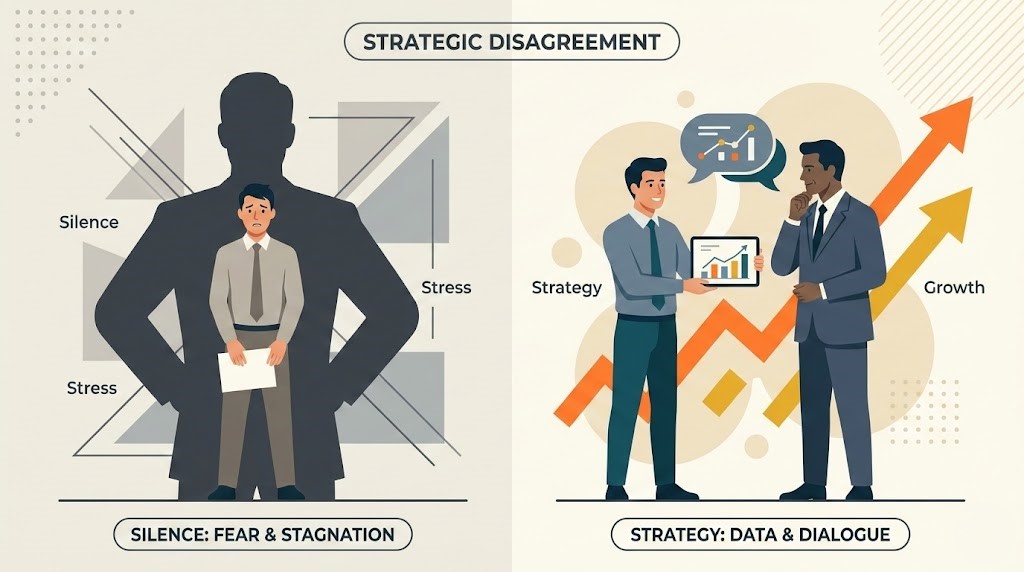
Our brains are wired to view disagreement with authority as a survival threat. In the 2026 workplace, however, the greater risk often lies in silence. When leadership demands unrealistic timelines or flawed strategies, they are often operating with limited visibility.
1.1 The Cost of Not Speaking Up
Communication expert Joseph Grenny suggests flipping the risk assessment. Instead of asking, “What happens if I speak up?” ask, “What is the cost of my silence?” If a project fails because you withheld your expertise, the fallout—wasted budgets, team burnout, and lost revenue—will likely be blamed on execution failure, which directly implicates you. In today’s data-driven performance reviews, “I knew it wouldn’t work” is not a defense; it is an admission of negligence.
1.2 Evaluating the Environment
Before launching into a debate, read the room. Is your boss currently under pressure from the board regarding Q1 earnings? Is the company undergoing a restructuring? Context matters. If the environment is toxic or retaliatory, silence might indeed be the safest short-term option. However, in most healthy organizations, leaders are desperate for course correction before resources are committed.
| Risk Factor | Silence (Passive) | Constructive Disagreement (Active) | Strategic Outcome |
|---|---|---|---|
| Project Failure | High probability. You become complicit in the failure. | Low probability. You mitigate risks early. | Reputation as a problem solver. |
| Relationship | Surface-level harmony, underlying resentment. | Temporary tension, long-term trust. | Seen as a partner, not a subordinate. |
| Career Impact | Stagnation. You are seen as an order-taker. | Visibility. You demonstrate leadership potential. | Positioned for promotion/retention. |
2. Prepare Your Argument Strategically
Disagreement is not a boxing match; it is a chess game. According to Holly Weeks, a communication expert referenced by HBR, spontaneity is your enemy when dealing with power dynamics. You need time to gather facts, not feelings.
2.1 The Waiting Game
Unless an immediate safety issue exists, do not disagree in the heat of the moment. Delaying your response allows you to cool down and collect data. For instance, if you are pushing back on a Return-to-Office (RTO) mandate that hurts productivity, don’t just complain about the commute. Gather team output data from remote days versus in-office days. Numbers depersonalize the conflict.
2.2 Finding Allies and Private Venues
Never challenge a senior leader in a public forum unless you have established high psychological safety. Public disagreement can trigger a defense mechanism, making them double down on a bad idea to save face. Schedule a 1:1 meeting. Additionally, vet your concerns with a peer. If they agree, you are not just a complainer; you are a representative of a valid operational concern.
| Preparation Step | Wrong Approach | Right Approach | Why It Works |
|---|---|---|---|
| Timing | Interrupting during the team meeting. | “Can we grab 10 minutes later to discuss the timeline?” | Protects the boss’s ego and reduces defensiveness. |
| Data | “I feel this is too rushed.” | “Based on past Q4 data, a 2-week sprint leads to a 15% error rate.” | Shifts focus from opinion to objective reality. |
| Permissions | Launching straight into the critique. | “I have a different perspective on this, may I share it?” | Gives the boss control and buy-in to listen. |
3. Use the Neutral Script Technique
The way you phrase your disagreement can determine whether you are seen as a strategic partner or a roadblock. The goal is to remain “neutral”—devoid of judgment-laden adjectives.
3.1 Removing Loaded Adjectives
Words like “hasty,” “naive,” “foolish,” or even “wrong” are emotional triggers. They attack the person, not the problem. Replace these with factual observations. Instead of saying, “This sales target is unrealistic,” say, “To hit this target, we would need a 40% increase in lead generation, which currently tracks at 5%.” This invites the boss to solve the math problem with you, rather than defend their intelligence.
3.2 Linking to Shared Goals
This is your strongest shield. Anchor your disagreement to a goal the boss cares about. If they care about speed, explain how their plan might actually cause delays due to rework. If they care about budget, show how the current path incurs hidden costs. By framing your objection as an obstacle to their success, you align yourself on the same side of the table.
| Scenario | Emotional Reaction (Don’t Do This) | Neutral & Goal-Oriented (Do This) | Underlying Logic |
|---|---|---|---|
| Unrealistic Deadline | “This is impossible. We’ll burn out.” | “If we launch on Tuesday, we risk skipping QA, which could impact our uptime goal.” | Connects delay to quality assurance (Business Value). |
| Bad Strategy | “That idea won’t work in this market.” | “I’m concerned this approach might conflict with our Q1 retention targets.” | Frames the idea as a risk to a shared KPI. |
| Resource Cut | “You’re setting us up to fail.” | “With the current headcount, we may need to deprioritize Project B to ensure Project A succeeds.” | Forces a trade-off decision rather than a complaint. |
4. Execute with Respectful Firmness
Once you are in the room and have presented your data, your demeanor must project calm confidence. Anxiety signals that you are unsure; aggression signals that you are a threat.
4.1 Validate and Reframe
Start by restating their point to prove you were listening. “So, the priority is to get the AI customer service bot live by March to reduce support costs. I understand that.” Then, pivot: “However, based on the beta tests, the error rate is still 12%. I recommend a soft launch in April to protect our Net Promoter Score.” You have validated their goal (cost reduction) while protecting another asset (customer satisfaction).
4.2 Disagree and Commit
Ultimately, the boss has the final say. If they hear your evidence and still decide to proceed, you must pivot to execution. Say, “I’ve shared my concerns, but I respect your decision. I will do my best to make this work.” This is not backing down; it is professional maturity. Paradoxically, this often earns you more respect than stubborn opposition.
References
- Harvard Business Review, “How to Disagree with Someone More Powerful” (Weeks & Grenny), 2021.
- Harvard Business Review, “Guide to Office Politics”, 2024.
- Bureau of Labor Statistics, “Employment Situation Summary”, January 2026.
Disclaimer
This article provides general career advice and should not be considered legal or psychological counseling. Workplace dynamics vary by culture and company policy.