
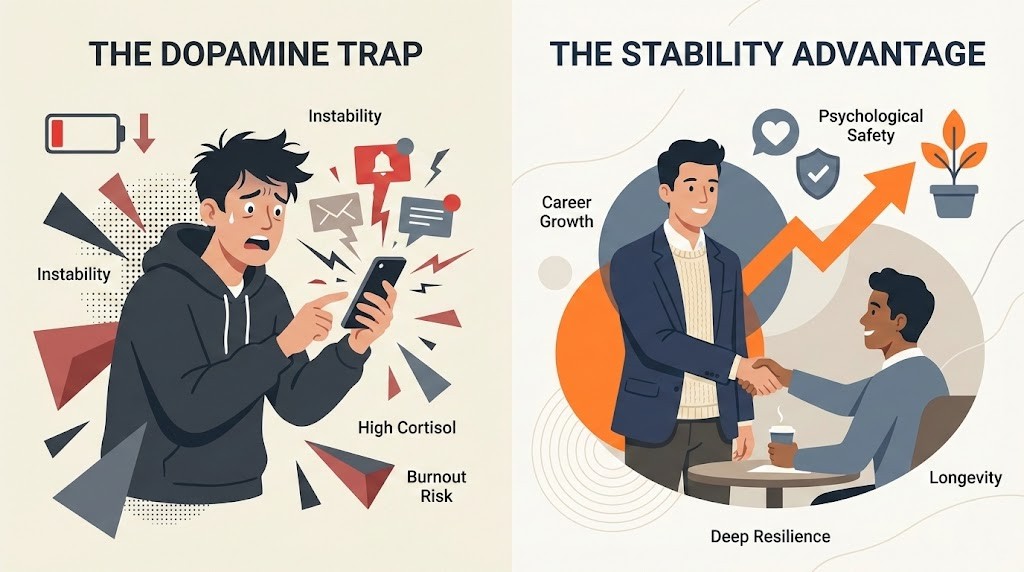
It’s Friday night. You check your phone. There’s a text from a friend asking, “How was your week?” It’s polite, consistent, and kind. And be honest—you probably ignored it to scroll through a chaotic news feed or reply to that one dramatic colleague who only calls when there’s a crisis. In 2026, we are collectively addicted to the “high” of instability. We mistake the adrenaline of drama for passion and label the safety of kindness as “boring.” But as the “Great Detachment” deepens in our workplaces and homes, this addiction is becoming expensive. New data from WHO and major business consultancies suggests that your ability to tolerate “boring” kindness is actually the strongest predictor of your physical longevity and career success. Let’s decode why your brain rejects the good guys and how to retrain it for a wealthier life.
1. The Neuroscience of Drama: Why We Reject “Nice”
Why does a peaceful weekend feel unsettling to so many of us? The answer lies not in your personality, but in your brain’s reward system. We have evolved to pay attention to threats and sudden changes. In the modern era, this evolutionary trait has been hijacked by what psychologists call “Variable Reward Schedules.”
1.1 The Dopamine Trap of Inconsistency
Think of a slot machine. If it gave you a coin every single time you pulled the lever, you would quickly get bored and walk away. But because the reward is unpredictable—sometimes nothing, sometimes a jackpot—you keep pulling. Toxic relationships and dramatic workplaces operate on this same mechanism. The “bad boy” or the chaotic boss gives you validation strictly on an unpredictable schedule. This spikes your dopamine levels significantly higher than the consistent, predictable kindness of a stable partner or a fair leader. We confuse this anxiety-induced dopamine spike with “chemistry” or “passion.”
1.2 Confusing Peace with Boredom
When you are accustomed to high-cortisol environments (stress), peace feels wrong. It feels like something is missing. In 2026, with our attention spans shattered by 15-second video clips, “boring” has become a dirty word. However, what we perceive as boredom is actually the absence of threat. Your nervous system is so used to being in “fight or flight” mode that safety feels foreign. We need to intellectually override this instinct.
| Brain State | Reaction to Drama (Chaos) | Reaction to Kindness (Stability) | Long-term Consequence |
|---|---|---|---|
| Neurotransmitter | Dopamine & Adrenaline (Spikes) | Oxytocin & Serotonin (Steady) | Adrenal Fatigue vs. Deep Resilience |
| Perception | “Exciting,” “Intense,” “Important” | “Boring,” “Predictable,” “Background” | Burnout vs. Sustainable Growth |
| Behavioral Loop | Addiction to the highs and lows | Taking it for granted (Neglect) | Cycle of crisis vs. Compound interest of trust |
2. The Hidden Cost of Ignoring Stability (Health & Wealth)
Dismissing “nice” people isn’t just a matter of preference; it is a public health hazard. The data from 2024 to 2026 paints a stark picture of what happens when we undervalue social connection.
2.1 Loneliness is the New Smoking
According to the WHO Commission on Social Connection (2024–2026), social isolation has hit critical levels globally. The mortality impact of being disconnected is equivalent to smoking 15 cigarettes a day. It is greater than the risks associated with obesity or physical inactivity. When we chase “exciting” but shallow relationships and ignore the “boring” friends who actually care, we are literally shortening our lifespans. The “boring” friend is your lifeline.
2.2 The Economic Penalty of Isolation
It’s not just health; it’s your wallet. Gallup’s recent findings on the “blind spot” of loneliness reveal that socially isolated employees are significantly less engaged and more likely to burn out. If you are a freelancer or an entrepreneur, the lack of a stable support network—those “nice” people you ignore—directly correlates to a drop in creative output and revenue. Stability is the foundation upon which risk-taking and innovation are built.
| Metric | The “Exciting” Path (Isolation/Drama) | The “Boring” Path (Stable Connection) | Impact on You |
|---|---|---|---|
| Health Risk | High Cortisol, Inflammation | Enhanced Immune System | Lower medical bills, longer life |
| Career Focus | Distracted by interpersonal conflict | Deep Work capability | Higher productivity, faster promotion |
| Resilience | Fragile (Breaks under pressure) | Antifragile (Grows under pressure) | Ability to bounce back from failure |
3. Reframing Kindness as a High-Performance Asset
Let’s talk business. There is a lingering myth that nice people finish last. In the cutthroat market of 2026, the opposite is true. “Nice” is no longer about being a pushover; it is about strategic emotional intelligence.
3.1 The ROI of Kindness in Leadership
The 2025 HumanKindex™ Report by Dexian shattered the illusion of the “tough boss.” The data shows that 87% of workers prioritize kindness in leadership when choosing an employer. More importantly, teams led by “kind” (stable, fair, respectful) leaders show significantly higher retention rates and profitability. Why? Because psychological safety allows for mistakes and innovation. If your team is terrified of your mood swings (drama), they will hide problems until they explode.
3.2 Stability as a Competitive Advantage
In a world that is volatile, uncertain, complex, and ambiguous (VUCA), being a consistent, reliable person is a massive differentiator. When everyone else is flaking, ghosting, or having a meltdown, the person who simply replies to emails on time and asks “How can I help?” becomes the most valuable player in the room. This is not “boring”; this is “professional reliability,” and it commands a premium in the labor market.
4. Curating Your Life: How to Appreciate the “Background”
So, how do we break the addiction to drama and start valuing the “nice” people? We need to treat them like high-art.
4.1 The Museum Mindset
Just as we visit a gallery to appreciate the subtle brushstrokes of a Monet or the quiet dignity of a Vermeer, we must consciously observe the “art” of kindness. It is easy to miss. The friend who listens without interrupting. The partner who makes coffee every morning. The colleague who covers for you. These are masterpieces of human behavior. Stop looking past them. Pause and admire the skill and restraint it takes to be that good in a chaotic world.
4.2 Practical Detox Plan
You need a dopamine detox for your relationships. Start by identifying the “drama magnets” in your life—the news sources, the influencers, the toxic friends who drain your energy—and limit your exposure to them. Simultaneously, set a “Gratitude Alarm.” Once a day, send a message to one of the “boring” reliable people in your life. A simple “I appreciate you” is enough. Watch how this small investment compounds over time.
| Action Item | Old Habit (Drama Seeking) | New Strategy (Stability Curating) | Expected Result (30 Days) |
|---|---|---|---|
| Communication | Ignoring texts, ghosting, reactive outbursts | Consistent replies, proactive check-ins | Deepening trust, reduced anxiety |
| Conflict | Escalating, blaming, seeking “winners” | De-escalating, listening, seeking solutions | Faster resolution, preserved relationships |
| Mindset | “This is boring, I need excitement” | “This is peaceful, I have space to think” | Clarity of thought, improved focus |
References
- WHO Commission on Social Connection (2024–2026), “Global State of Social Connection Report.”
- Dexian (2025), “The HumanKindex™ Report: The ROI of Kindness in the Workplace.”
- Gallup & Meta (2024), “The State of Social Connections.”
- Harvard Study of Adult Development (2025 Update), “Social Fitness and Longevity Findings.”
Disclaimer
This content is for informational purposes only and does not constitute professional psychological or medical advice. If you are experiencing severe isolation or mental health crises, please consult a qualified healthcare professional.