
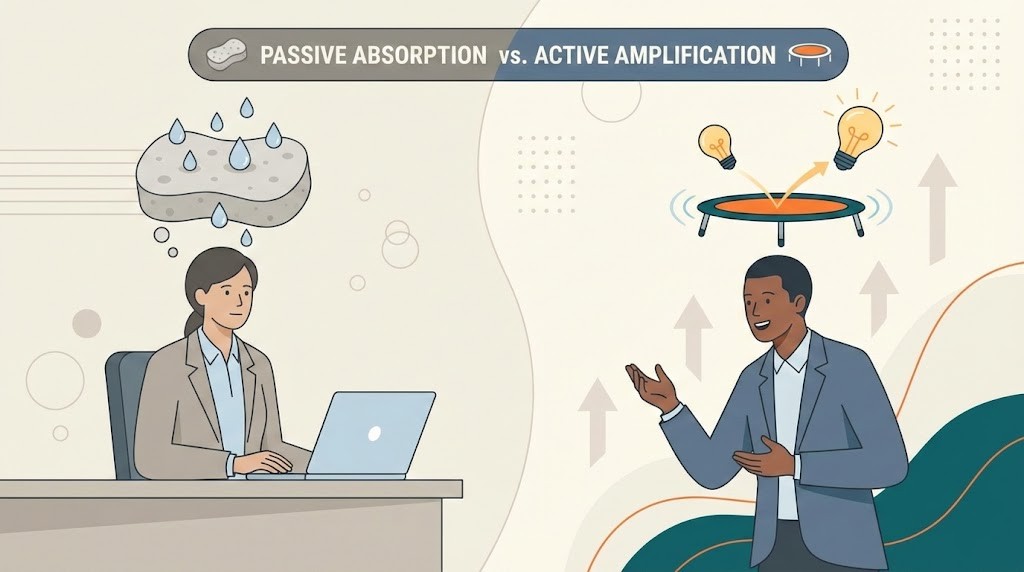
You are sitting in a high-stakes performance review or a final-round interview. You lean in, maintain eye contact, and nod at every sentence your manager or the recruiter speaks. You even repeat their last three words to show you are paying attention. You leave the room feeling confident, only to receive feedback later that you seemed “disengaged” or “lacked initiative.” This is the silent killer of modern careers: the myth of passive listening. According to recent 2026 labor market insights, companies are no longer just looking for people who follow instructions; they are desperate for ‘Active Contributors’ who can amplify ideas. If you feel like your career has hit a plateau despite being a “good person” who listens, you might be trapped in a ‘Sponge’ mindset when the world demands a ‘Trampoline.’
1. The Difference Between Absorbing Information and Amplifying Ideas
Most of us were taught that listening is a silent act. We were told to be like a sponge—absorb everything, stay quiet, and don’t interrupt. While this feels respectful, it often leaves the speaker feeling like they are talking to a brick wall. In a fast-paced professional environment, being a sponge is the bare minimum; it doesn’t add value.
1.1 The Limitations of the Sponge Approach
A sponge simply takes in water. In a meeting, a ‘Sponge Listener’ takes notes and stays silent. While you aren’t doing anything wrong, you aren’t helping the idea grow. This often leads to missed opportunities for promotion because leadership cannot see your thought process or your ability to handle complex information.
1.2 The Power of the Trampoline Effect
Great listeners act like a trampoline. When someone throws an idea at you, you don’t just catch it; you give it height, energy, and direction. You ask questions that push the speaker to think deeper. This shift from passive absorption to active amplification is what separates entry-level employees from senior leaders. You aren’t just hearing words; you are building a bridge to the next solution.
| Analysis Item | Traditional Passive Listening | Active Trampoline Listening | Action Strategy |
|---|---|---|---|
| Primary Goal | Accuracy and Silence | Insight and Acceleration | Ask “What if” instead of just “Okay” |
| Interaction Style | One-way Absorption | Two-way Energy Exchange | Provide verbal cues that build on the topic |
| Perceived Value | Reliable Follower | Strategic Partner | Challenge the premise with respect |
2. Four Patterns of Listening That Shape Your Professional Reputation
How you listen tells people more about your competence than how you speak. Most professionals default to one of four styles, but the most successful individuals know how to switch between them depending on the situation. Understanding your default mode is the first step toward career maturity.
2.1 Task-Oriented and Analytical Listening
Task-oriented listeners are focused on efficiency. They want the ‘bottom line’ quickly. Analytical listeners try to deconstruct the problem from a neutral ground. While these are great for technical roles, they can often come across as cold or impatient in high-pressure emotional situations, such as managing a burnt-out team member.
2.2 Relational and Critical Listening
Relational listeners focus on building connections and emotional cues. Critical listeners judge both the content and the speaker’s credibility. The danger lies in over-using one style. If you are always critical, people stop sharing innovative (but raw) ideas with you. If you are only relational, you might miss the logical flaws in a failing project plan.
3. Common Mistakes That Make You Appear Dismissive Instead of Empathetic
One of the most surprising findings in modern communication research is that sharing your own similar experience can actually hurt the conversation. We do it to show empathy, but it often shifts the spotlight away from the person who actually needs it.
3.1 The Hijacking of the Narrative
When a colleague says, “I’m struggling with the new software,” and you respond with, “Oh, I had a hard time with that too, let me tell you how I fixed it,” you have effectively ended their turn to speak. You’ve made it about you. This is ‘Conversational Narcissism’ disguised as help.
3.2 The Information Bubble for Leaders
For those in management, the stakes are higher. If you don’t actively seek out dissenting voices, your team will only tell you what they think you want to hear. This creates an ‘Information Bubble’ where you are the last to know when a project is failing. Breaking this bubble requires asking questions that invite ‘bad’ news without punishment.
| Mistake Type | What We Think It Shows | What It Actually Signals | Correction Method |
|---|---|---|---|
| Self-Referencing | Empathy and Connection | Dismissal of Speaker’s Feelings | Ask one more follow-up question before sharing |
| Parroting | Proof of Listening | Lack of Real Understanding | Summarize the ‘meaning,’ not just the words |
| Premature Advice | Problem-Solving Skills | Control and Superiority | Ask: “Do you need a solution or a sounding board?” |
4. Practical Methods to Become a High-Value Strategic Communicator
Becoming a ‘Trampoline Listener’ isn’t about personality; it’s about specific habits. It requires quieting your internal monologue—that voice in your head planning what to say next—and focusing entirely on the gaps in the current story.
4.1 Asking Questions About What Is Missing
The most powerful listeners look for what isn’t being said. If an employee is hesitant about a deadline, don’t just reassure them. Ask: “What specific part of this timeline feels the most uncertain?” This signals that you are listening to their tone and subtext, not just their literal words.
4.2 Establishing a Safe Environment for Truth
In 2026, the most valuable leaders are those who prioritize trust over hierarchy. This means responding to feedback with curiosity instead of defense. When you react to a challenge with “Tell me more about why you see it that way,” you instantly increase your professional value and the psychological safety of your entire organization.
| Toolbox | Key Phrase to Use | Expected Outcome | Professional Impact |
|---|---|---|---|
| The Insight Probe | “What am I missing here?” | Uncovers hidden risks | Risk Mitigation Specialist |
| The Validation Bridge | “It sounds like you’re concerned about…” | Builds deep rapport | Trusted Leader Reputation |
| The Expansion Cue | “How would that look in practice?” | Turns ideas into action | Strategic Value Creator |
References
- Harvard Business Review, “The Art of Active Listening: The HBR Guide,” 2022.
- Zenger, J., & Folkman, J., “What Great Listeners Actually Do,” Harvard Business Review Press, 2016 (Updated 2024).
- LinkedIn Talent Solutions, “Global Talent Trends: The Rise of Soft Skills,” 2025.
Disclaimer
This content is for informational purposes only and does not constitute professional career coaching or legal advice. For specific workplace disputes or psychological support, please consult with a certified HR professional or a licensed counselor in your jurisdiction.