
Picture this: You’re in a crucial team meeting, pitching an idea you’ve worked on for weeks. You’re passionate, prepared, and articulate. But as you scan the room, you see glances at phones, polite but vacant nods, and eyes darting toward the clock. When you finish, there’s a beat of silence before someone shifts gears entirely, completely bypassing your contribution. This all-too-common scenario isn’t just frustrating; it’s a symptom of a massive, overlooked drain on professional success and organizational productivity. In an era obsessively focused on broadcasting our own voices and leveraging AI to generate content, the profoundly human skill of truly hearing others is becoming obsolete—and therefore, immensely valuable. This deep dive explores why becoming a master listener is the single most effective strategy for future-proofing your career and elevating your professional standing right now.
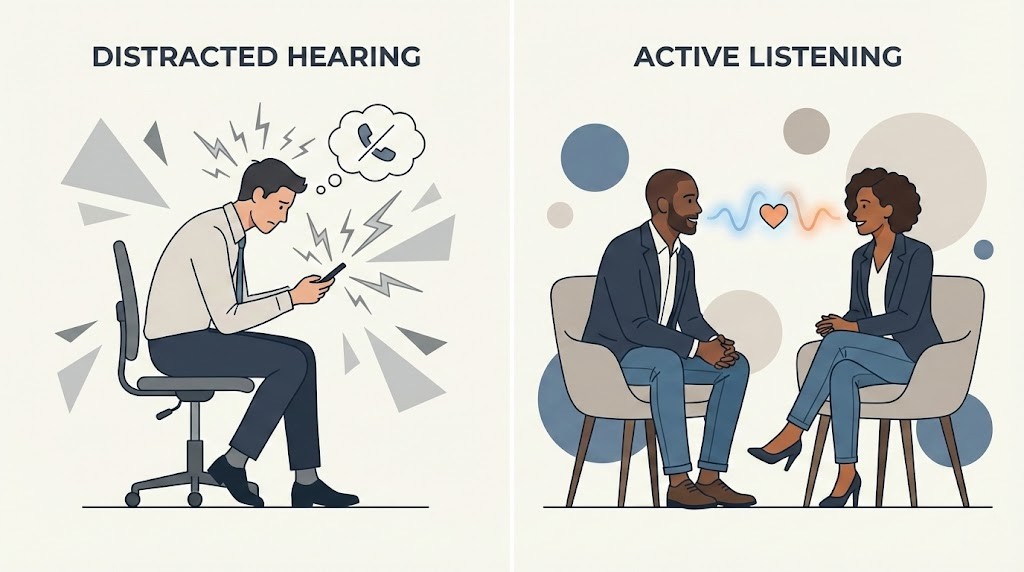
1. The Measurable Costs of Poor Listening
We often treat listening as a passive, background activity, a pause between our own turns to speak. However, the failure to listen effectively is an active destructor of value in the workplace. It’s not a soft issue; it has hard, calculable consequences that directly impact efficiency, morale, and ultimately, the bottom line for businesses and individuals alike.
1.1 The Financial Impact of Miscommunication
When instructions are misunderstood, feedback is ignored, or concerns go unheard, the result is rarely zero. It is almost always a negative integer. Tasks must be redone, projects miss deadlines, and opportunities are lost to competitors who understood the client’s needs better. Recent analyses from 2025 highlight staggering figures related to inefficient communication across organizations. For large enterprises, the cumulative cost of employees spending hours clarifying misinterpretations, correcting errors stemming from poor instructions, and navigating friction caused by unheard perspectives runs into the billions annually. On an individual level, think about the time you spend revisiting work because the initial brief wasn’t fully absorbed—that’s direct productivity loss that compounds over a career.
1.2 The Erosion of Trust and Engagement
Beyond direct financial losses, chronic poor listening acts as a corrosive agent on workplace culture and individual engagement. When employees or colleagues feel their input enters a void, they psychologically disengage. This phenomenon is distinct from burnout; it’s a rational withdrawal of effort in response to being chronically undervalued. The “quiet quitting” trend discussed heavily in recent years has roots in this dynamic. A leader who doesn’t listen cultivates a team that doesn’t speak up, killing innovation and proactive problem-solving. The table below breaks down these multifaceted costs, showing that what we often dismiss as a “communication style” issue is a significant operational liability.
| Impact Area | The “Business as Usual” Approach (Poor Listening) | The High-Cost Consequence | The Active Listening Advantage |
|---|---|---|---|
| Project Execution | Instructions are partially heard; assumptions replace clarification. | Frequent rework, missed deadlines, blown budgets due to avoidable errors. | Alignment on goals from day one; proactive identification of potential roadblocks. |
| Team Dynamics | Conversations are competitive; individuals listen to respond, not to understand. | Low trust, high conflict, formation of silos, reduced information sharing. | Psychological safety, high collaboration, rapid and effective conflict resolution. |
| Talent Retention | Employees feel unheard and undervalued; concerns are dismissed. | High turnover of top talent, “quiet quitting,” disengaged workforce. | Increased loyalty, higher engagement, stronger employer brand and talent attraction. |
| Client Relations | Sales and service teams push their own agenda rather than digging into client needs. | Lost contracts, high client churn, poor reputation in the market. | Deep client trust, tailored solutions that stick, long-term high-value partnerships. |
2. The AI Paradox: Why High-Tech Makes Soft Skills Scarce
As we navigate 2026, generative AI has become embedded in nearly every professional workflow. From drafting emails and generating code to analyzing massive datasets and creating strategic reports, machines are rapidly taking over tasks that require information processing and output generation. This technological shift is forcing a fundamental re-evaluation of human value in the labor market.
2.1 The Shift in In-Demand Skills
For decades, technical proficiency—the ability to code, to model finance, to operate complex machinery—was the golden ticket. Now, as AI democratizes technical execution, the differentiator is shifting back to deeply human capabilities. According to leading economic forecasts and job market analyses, including the World Economic Forum’s Future of Jobs projections for 2025 and beyond, skills centered around human interaction, emotional intelligence, and complex problem-solving are rising sharply in demand. While an AI can transact information perfectly, it cannot build rapport, navigate a delicate political situation through nuance, or make a person feel genuinely understood and validated in a moment of stress. These are the domains of the master listener.
2.2 Listening as a Non-Automatable Asset
True listening is not just data intake; it is a complex cognitive and emotional process. It involves interpreting tone, reading subtle body language, understanding cultural context, and sensing unspoken emotions. It requires empathy—the ability to step outside your own perspective and inhabit another’s. No current or foreseeable AI model can authentically replicate this dimension of human connection. Therefore, professionals who cultivate this skill are building a moat around their careers. They become the indispensable bridges between human needs and technological capabilities, the leaders who can rally teams through uncertainty, and the negotiators who can forge agreements where logic alone fails. The table below illustrates this divergence in skill value.
| Capability Domain | AI’s Role & Proficiency (2026) | Human’s Unique Value Proposition | Future Career Outlook |
|---|---|---|---|
| Data Processing & Analysis | Dominant. Can process vast amounts of data instantly and identify patterns. | Contextual Interpretation. Asking the “why” behind the data and applying ethics. | Human role shifts from analyst to strategic interpreter and governor. |
| Content Generation | High Proficiency. Can draft reports, emails, code, and marketing copy quickly. | Strategic Nuance & Empathy. Crafting messages that resonate emotionally and politically. | Human role focuses on high-level strategy, tone calibration, and final judgment. |
| Active Listening & Empathy | Low/None. Can transcribe words but cannot genuinely feel or validate emotions. | Essential & Irreplaceable. Building trust, resolving conflict, fostering psychological safety. | Demand will grow significantly as these skills become rarer and more critical. |
| Complex Negotiation | Supportive. Can model scenarios and provide data-driven options. | Primary Driver. Reading the room, building rapport, intuitive leaps, and creative compromise. | Remains a deeply human-centric high-value activity. |
3. Moving Beyond the Performance of Paying Attention
Most of us believe we are good listeners. We know the standard advice: maintain eye contact, nod occasionally, and throw in a “mhmm” or “I see” every now and then. Behavioral science, as highlighted by educational platforms like TED-Ed, reveals that this is often mere performance—a pantomime of listening designed to be polite rather than a genuine effort to understand. True listening is an internal cognitive commitment, not just an external physical posture.
3.1 The Illusion of the “Good Listener” nod
Researchers have found that rote behaviors like smiling and nodding at set intervals are ineffective at making the speaker feel truly heard. In fact, they can backfire if they don’t align with the actual content of what’s being said, signaling inauthenticity. Genuine listening requires a shift in intention from “waiting to talk” to “seeking to understand.” It’s about suppressing your internal monologue, your urge to offer immediate solutions, or your impulse to relate their story back to your own experiences. It’s a state of focused receptivity that is surprisingly energy-intensive.
3.2 The Digital Barrier to Deep Connection
In our current environment, the single biggest obstacle to this level of focus is often sitting right on the table between us. Studies in psychology, including research from the University of Essex validated over the years, have consistently shown that the mere visible presence of a smartphone—even if it’s face-down and silent—reduces the perceived quality of a conversation. It acts as a psychological cue that says, “There is something else more important than you right now.” It divides attention and inhibits the formation of deeper interpersonal connections. Removing this digital barrier is a simple yet profound physical signal of your commitment to the present moment and the person in front of you. The following table outlines the difference between performative and genuine listening behaviors.
| Behavior Checklist | Performative Listening (The Standard) | Active & Empathetic Listening (The Goal) |
|---|---|---|
| Primary Intention | To be polite while waiting for a turn to speak or offer advice. | To fully understand the speaker’s perspective, feelings, and underlying message. |
| Focus & Attention | Divided. Multi-tasking internally, checking phone, scanning the room. | Undivided. Phone away, environment minimized, full cognitive focus on the speaker. |
| Body Language | Generic nodding and smiling, sometimes out of sync with the speaker’s tone. | Open posture, mirroring, and authentic non-verbal cues that reflect real-time understanding. |
| Verbal Interaction | Interrupts with own stories (“That reminds me of…”) or immediate fixes (“You should just…”). | Uses silence comfortably. Asks open-ended clarifying questions. Summarizes to confirm understanding. |
| Outcome | Speaker feels rushed, dismissed, or managed. No new understanding is gained. | Speaker feels valued, psychologically safe, and understood. Trust is deepened. |
4. A Tactical Guide to Becoming a World-Class Listener
Understanding the value of listening is the first step; cultivating the skill is a deliberate practice. It doesn’t happen overnight, but by consciously adopting specific behaviors, you can retrain yourself to be a far more effective communicator. These are practical, tactical steps you can begin implementing in your very next conversation to signal your attentiveness and improve your understanding.
4.1 Master the Art of the Pause
In many fast-paced business cultures, silence is viewed as dead air to be filled immediately. However, for a master listener, silence is a powerful tool. When someone finishes speaking, resist the urge to jump in instantly. Take a beat—two or three seconds of silence. This accomplishes two things: first, it shows the speaker you are actually processing what they said, not just firing off a pre-loaded response. Second, it often encourages the speaker to continue, leading them to share deeper, more nuanced information that they might have held back if rushed. Embrace the pause; it’s where real thinking happens.
4.2 The Power of Reflective Summarizing
One of the most effective techniques from behavioral science is reflective listening. This involves paraphrasing what you believe you heard and repeating it back to the speaker for confirmation. You might say, “It sounds like your main concern is that the new timeline doesn’t account for the QA bottleneck, is that right?” This is powerful because it serves a dual purpose: it allows you to verify your own understanding and correct any misinterpretations immediately, and crucially, it provides immense psychological validation to the speaker. Hearing their own thoughts accurately reflected back to them is the ultimate proof that you were truly listening.
4.3 Cultivating Constructive Curiosity
Shift your questioning strategy from interrogating to exploring. Instead of asking closed yes/no” questions or leading questions that confirm your own biases ask open-ended questions born of genuine curiosity. Ask “”What led you to that conclusion?”” or “”How did that situation impact the rest of the team?”” or “”What’s the most critical thing we need to solve for right now?”” These questions invite narrative and depth. They signal that you value their expertise and perspective fostering a collaborative environment rather than a combative one. By consistently applying these tactics you transform listening from a passive intake process into an active strategic leadership behavior.
References
- World Economic Forum The Future of Jobs Report 2025 2025.
- Grammarly & The Harris Poll The State of Business Communication: The Path to Productivity Growth and Profit 2025.
- Axios HQ The Cost of Miscommunication in the Workplace Report 2025.
- TED-Ed 4 things all great listeners know (Video created by Iseult Gillespie) 2022.
- Psychology Today Analyses on the Impact of Smartphones on Social Interaction (referencing studies like those from the University of Essex) 2024-2026.
Disclaimer
The information provided in this article is for educational and professional development purposes only and should not be considered as professional psychological or career counseling advice. The statistics and data mentioned are based on available reports at the time of writing and are subject to change. Readers are encouraged to consult with qualified professionals for specific advice tailored to their individual situations and organizational contexts.
“