
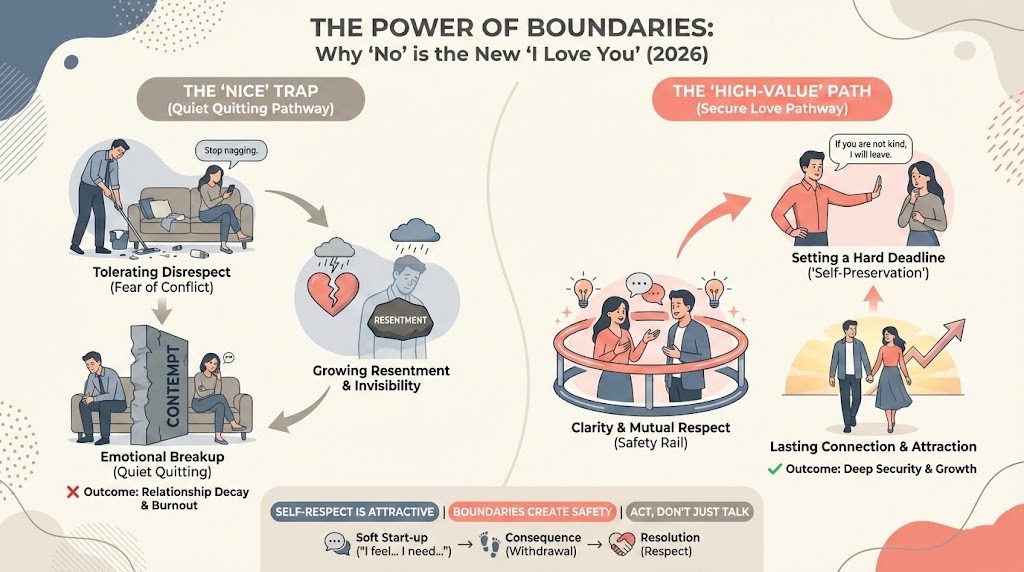
Imagine coming home after a 10-hour shift at a tech firm in Austin or a finance job in London. You are exhausted. Your partner, who promised to handle dinner, is on the couch, scrolling through TikTok, surrounded by takeout boxes from two days ago. When you ask why, they snap, “Stop nagging me.” You sigh and clean up the mess yourself. Again. This isn’t a movie scene; it is the reality for millions of professionals in 2026 who are silently suffering from “Quiet Quitting in Relationships.” We have been taught that true love means endless patience. But recent data from The Gottman Institute suggests that this “tolerance” is actually the fastest route to divorce. Today, we explore why the most romantic sentence isn’t “I will love you forever,” but rather, “If you stop being kind to me, I will leave.”
1. The High Cost of Unconditional Tolerance in 2026
In the post-pandemic era, we have seen a massive shift in how we view labor, both in the office and at home. Just as employees are refusing to do unpaid overtime, partners are waking up to the cost of “emotional unpaid labor.” However, many of us are still trapped in the myth that being a “good partner” means absorbing negativity without complaint.
1.1 The “Quiet Quitting” Phenomenon in Marriage
You might have heard of “Quiet Quitting” in the workplace, but in 2025 and 2026, psychologists are seeing it explode in domestic life. According to reports from *The Guardian* and *Psychology Today*, couples are increasingly staying together for financial reasons or fear of loneliness, while emotionally checking out completely. This happens when one partner repeatedly tolerates disrespect. The result isn’t peace; it is a cold war. When you tolerate laziness or rudeness, you aren’t being kind; you are training your partner to see your needs as optional.
1.2 The Physiology of Toxic Endurance
Enduring a bad relationship doesn’t just hurt your feelings; it damages your biology. A 2025 study referenced in *Journal of Pubmedia* indicates that individuals in relationships characterized by chronic unresolved conflict show cortisol levels comparable to those suffering from PTSD. Your body keeps the score. The chest pain you feel when your partner dismisses your concerns is a biological warning signal. Ignoring it in the name of “romance” is a health risk.
| Metric | Healthy Boundaries | Unlimited Tolerance (The “Nice” Trap) | Impact on Relationship Survival |
|---|---|---|---|
| Partner’s Behavior | Adjusts to respect limits | Becomes progressively worse | Boundaries increase survival by 60% |
| Emotional State | Secure and Valued | Resentful and Invisible | Resentment is the #1 predictor of breakups |
| Conflict Resolution | Addressed immediately | Avoided until explosion | Early resolution prevents “Contempt” |
2. The Psychology of Human Limits and Respect
Why do people we love treat us poorly? It is rarely because they are evil villains. It is because they are human. The School of Life’s analysis, supported by behavioral psychology, suggests that human beings are opportunistic. We expand into the space allowed to us.
2.1 The “Empty Fridge” Theory
Think about a roommate situation. If you always refill the fridge when it is empty, your roommate will never learn to do it. They aren’t necessarily bad people; they are just adapting to an environment where the fridge “magically” refills itself. In love, if you accept cancelled plans, sarcasm, or emotional neglect, your partner’s brain registers this as the “acceptable baseline.” You are effectively signing a contract that says, “Treating me this way costs you nothing.”
2.2 The Four Horsemen: Why Contempt is Fatal
The Gottman Institute has famously identified four behaviors that predict divorce with over 90% accuracy. The most dangerous one is Contempt—treating your partner with superiority or disgust (e.g., eye-rolling, mocking). Contempt doesn’t appear overnight. It grows in the soil of unchecked bad behavior. By tolerating small disrespects today, you are inviting contempt tomorrow. Setting a strict limit is the only way to prevent this cancer from taking root.
| Stage of Decay | Typical Warning Sign | The “Nice” Response (Wrong) | The “High-Value” Response (Right) |
|---|---|---|---|
| Stage 1: Testing | Partner cancels date last minute | “It’s okay, I understand.” | “I’m disappointed. I value our time, so please let me know 24h in advance next time.” |
| Stage 2: Habit | Partner ignores your texts for hours | Double texting, worrying | Stop texting. Address it face-to-face: “I need a partner who communicates.” |
| Stage 3: Entitlement | Partner snaps at you for no reason | Silence or crying alone | “I do not accept being spoken to that way. We can talk when you are ready to be respectful.” |
3. Why “I Will Leave” Is a Promise of Safety, Not a Threat
This brings us to the core philosophy: The most romantic thing you can say is, “If you are not nice to me, I will leave.” This sounds harsh to the uninitiated, but let us deconstruct why this is actually a statement of profound love and safety.
3.1 Protecting the Relationship from Decay
When you say this, you are not saying, “I don’t love you.” You are saying, “I love us too much to let us degenerate into a toxic couple.” You are acting as the guardian of the relationship’s quality. It is like a safety rail on a balcony; it exists not to restrict movement, but to prevent a fatal fall. A partner who knows you have high standards feels safer because they know you won’t secretly resent them for years. They know exactly where the line is.
3.2 The Attraction of Self-Respect
Let’s be honest about attraction. Desperation is a libido killer. Confidence is an aphrodisiac. A person who is terrified of being alone will accept anything. A person who knows they can survive alone—and chooses to be with you—is incredibly attractive. By demonstrating that you have options and standards, you trigger a primal respect in your partner. They realize, “I need to step up to keep this person.”
4. A Step-by-Step Guide to Reclaiming Your Standards
So, how do you implement this without causing World War III tonight? You don’t need to be aggressive. You need to be firm, calm, and consistent. Here is your action plan for 2026.
4.1 The “Soft Start-up” Technique
Dr. John Gottman suggests starting difficult conversations without blame. Instead of saying, “You never listen to me” (which triggers defensiveness), try the formula: “I feel [emotion] about [situation] and I need [positive need].”
Example: “I feel lonely when we don’t talk at dinner. I need us to have 20 minutes of phone-free time because I love connecting with you.” If they reject this reasonable request, then you escalate to setting the boundary.
4.2 The Consequence Protocol
A boundary without a consequence is just a suggestion. If your partner crosses the line you set, you must act. This doesn’t mean breaking up immediately. It means withdrawing your labor or presence.
1. Verbal Warning: “I mentioned I can’t tolerate yelling. If you continue, I will leave the room.”
2. Immediate Action: If they yell again, walk out. Do not argue. Go to a café. Turn off your phone for an hour.
3. The Final Stand:*If the behavior becomes a pattern, sit them down. “I love you, but I cannot stay in a relationship where I am disrespected. I need to see a change, or I will have to rethink our future.”
| Action Level | Scenario | Script / Action | Expected Outcome |
|---|---|---|---|
| Level 1: Correction | Sarcastic comment in public | “Please don’t make jokes at my expense. It hurts.” | Partner realizes boundaries exist. |
| Level 2: Withdrawal | Repeated negligence of chores | Stop doing their share. Hire a cleaner for yourself only or let dishes pile up. | Partner faces natural consequences. |
| Level 3: Departure | Emotional abuse or cheating | “I am leaving because I value myself too much to stay.” | Self-preservation and recovery. |
References
- The Gottman Institute. (2025). The State of Relationships 2025: Why Boundaries Prevent Divorce. Seattle: The Gottman Institute Research Division.
- Gallup. (2025). State of the Global Workplace & Emotions Report 2025. Washington, D.C.: Gallup, Inc.
- The School of Life. (2016). The Most Romantic Thing You Can Ever Say to Someone. London: The School of Life Press.
- Psychology Today. (2025). Quiet Quitting in Marriage: The Silent Epidemic. New York: Sussex Publishers.
Disclaimer
The information provided in this article is for educational purposes only and does not constitute professional psychological or relationship advice. If you are experiencing domestic violence or severe emotional distress, please contact a certified mental health professional or your local emergency services immediately.