Imagine it is 9:00 AM on a Tuesday in January 2026. You are a high-performing executive who has consistently delivered results for over a decade. But today, your access badge does not work, and your calendar has been wiped clean. The silence is deafening. This is not a hypothetical nightmare; it is the reality for thousands of professionals amidst the current ‘White-Collar Recession.’ According to the December 2025 Challenger, Gray & Christmas report, over 1.1 million corporate positions were eliminated last year alone. In this volatile landscape, equating your identity solely with your career is not just a psychological burden—it is a systemic risk. This guide analyzes why ‘Work-Enmeshment’ is dangerous and provides a data-backed strategy to diversify your identity portfolio before the market forces you to.
1. The Psychological Risks of Equating Self-Worth with Career Success
For many professionals, the question “Who are you?” instinctively triggers a response about their job title or employer. This phenomenon, known as ‘Work-Enmeshment,’ occurs when the boundaries between an individual’s personal identity and their professional role completely dissolve. While this may drive short-term performance, it creates a fragile psychological foundation where professional setbacks are experienced as existential threats.
1.1 The Correlation Between High Achievement and Identity Fragility
Paradoxically, the most successful individuals often face the highest risk. When you invest decades into climbing a corporate ladder, your neural pathways reinforce the belief that your value is contingent on external validation—promotions, bonuses, and titles. This creates a “success trap.” According to 2025 data from Mental Health America (MHA), 60% of high-income white-collar workers who experienced a layoff reported immediate symptoms of severe anxiety or identity disassociation, significantly higher than the average for blue-collar roles. The higher you rise, the more you have to lose, and the more terrifying the prospect of ‘professional death’ becomes.
1.2 Burnout as a Symptom of Identity Over-Investment
The refusal to disconnect is often celebrated as dedication, but physiologically, it is a state of chronic stress. The Gallup State of the Global Workplace 2025 report highlights a disturbing trend: 82% of managers and executives are now classified as ‘at risk’ for burnout, a 5% increase from the previous year. This is not merely about workload; it is about the emotional weight of carrying a professional mask 24/7. When your entire self-worth is leveraged on a single asset—your job—you exist in a perpetual state of defensive anxiety, fearing that any slip will destroy your entire world.
| Identity Indicator | Work-Enmeshed State (High Risk) | Healthy Detachment (Resilient) | Strategic Adjustment |
|---|---|---|---|
| Self-Description | “I am a VP at [Company Name].” | “I work in finance, but I am also a runner/mentor.” | Separate ‘Who I am’ from ‘What I do’. |
| Reaction to Feedback | Constructive criticism feels like a personal attack. | Criticism is data for professional improvement. | View roles as temporary projects, not permanent traits. |
| Time Off | Anxious, checking emails, feeling ‘invisible’. | Fully disengaged, recharging other parts of life. | Enforce digital detox boundaries strictly. |
2. Market Reality: The White-Collar Recession and Job Instability
It is essential to recognize that the anxiety surrounding career loss is not purely internal; it is a rational response to a shifting economic environment. The era of the ‘forever job’ is officially over, and the 2026 labor market presents unique challenges for knowledge workers.
2.1 Analyzing the 2025-2026 Layoff Trends
We are currently witnessing a structural shift often termed the ‘White-Collar Recession.’ Unlike previous downturns that primarily affected manual labor, the current wave of rightsizing targets middle management and high-salaried specialized roles. The Challenger, Gray & Christmas report from December 2025 confirms that corporate cuts have exceeded 1.1 million, the highest level since the early 90s recession excluding the pandemic anomaly. Companies are flattening hierarchies and integrating AI agents, rendering many traditional ‘oversight’ roles obsolete. In this context, clinging to a job title as a permanent badge of honor is a miscalculation of market dynamics.
2.2 Why Financial Preparation Is Not Enough
Most professionals prepare for job loss financially—building an emergency fund or severance negotiation strategy—but fail to prepare psychologically. However, the data suggests that the psychological shock is often what derails the subsequent job search. A depressed candidate projects desperation, which is a red flag for recruiters. The OECD Economic Outlook 2025 notes that while unemployment rates remain statistically low (around 2.5-3.5% in major economies), the duration of unemployment for senior roles has extended by 40%. This gap requires not just financial runway, but ‘identity runway’—the ability to maintain self-esteem without a title for 6 to 12 months.
| Market Factor | 2020 Landscape | 2026 Reality | Implication for You |
|---|---|---|---|
| Job Security | Focus on retention during the ‘Great Resignation’. | Focus on efficiency and AI integration. | Your role is liquid; treat it as a temporary contract. |
| Hiring Cycles | Average 2-3 months for executive roles. | Average 5-8 months due to rigorous vetting. | You need stronger mental endurance for long gaps. |
| Skill Valuation | Deep specialization in one domain. | Adaptive generalist with AI fluency. | Rigid identities prevent necessary skill pivoting. |
3. Strategic Response: The Career Risk Simulation Exercise
If the fear of losing your professional identity is paralyzing, the most effective antidote is not positive thinking, but exposure therapy. We adapt the ancient concept of ‘Maranasati’ (mindfulness of death) into a practical corporate exercise: The Career Risk Simulation.
3.1 Visualizing Professional Mortality
This exercise involves vividly imagining the end of your career in stages. By walking your brain through the worst-case scenario, you desensitize the amygdala—the fear center of the brain—and engage the prefrontal cortex to plan rationally. It removes the ‘monster in the closet’ effect. When you realize that you still exist even after your title is gone, the fear loses its grip, allowing you to perform better in your current role because you are no longer operating from a place of desperation.
3.2 The 9-Step Simulation Protocol
Arthur Brooks and other behavioral scientists suggest a structured approach. Do not just think “what if I get fired?” Instead, visualize the specific degradation of your status. 1. You lose your influence in meetings. 2. You are excluded from key emails. 3. Rumors start. 4. The HR meeting happens. 5. You hand over your badge. 6. Former colleagues stop calling. 7. You are forgotten by the industry. 8. You move to a smaller house. 9. You find a new, different life. By mentally living through step 9, you realize that life continues. This is ‘Stoicism’ applied to modern career management.
| Simulation Stage | Typical Fear Response | Stoic Strategic Response | Action Item |
|---|---|---|---|
| Stage 1: Exclusion | Paranoia and political maneuvering. | Objective observation of signal vs. noise. | Update resume and reconnect with network immediately. |
| Stage 2: Termination | Panic, shame, and isolation. | Acceptance of a business decision. | Draft a negotiation script for severance packages. |
| Stage 3: Irrelevance | Depression and loss of purpose. | Freedom to reinvent oneself. | List 5 interests suppressed by your current job. |
4. Portfolio Strategy: Diversifying Identity Assets for Resilience
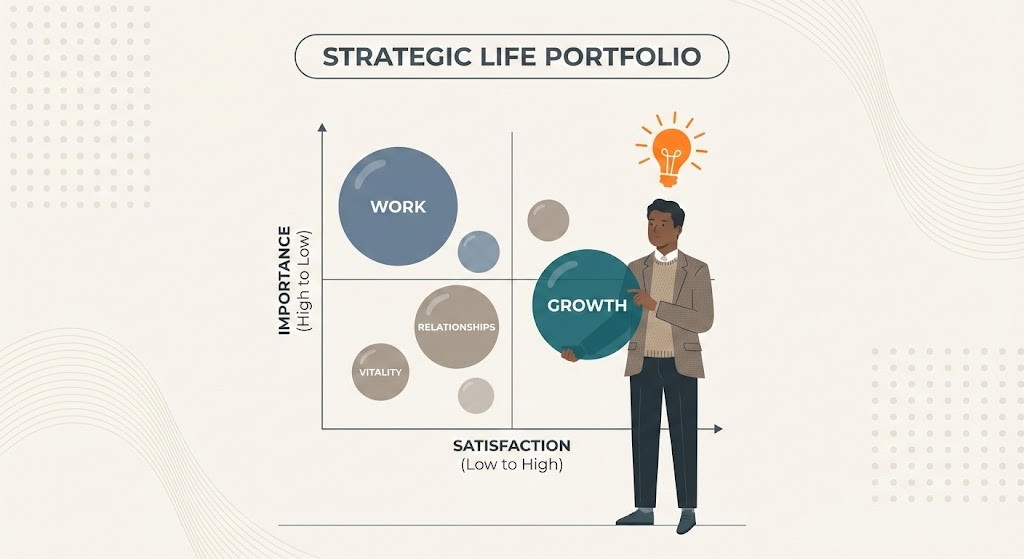
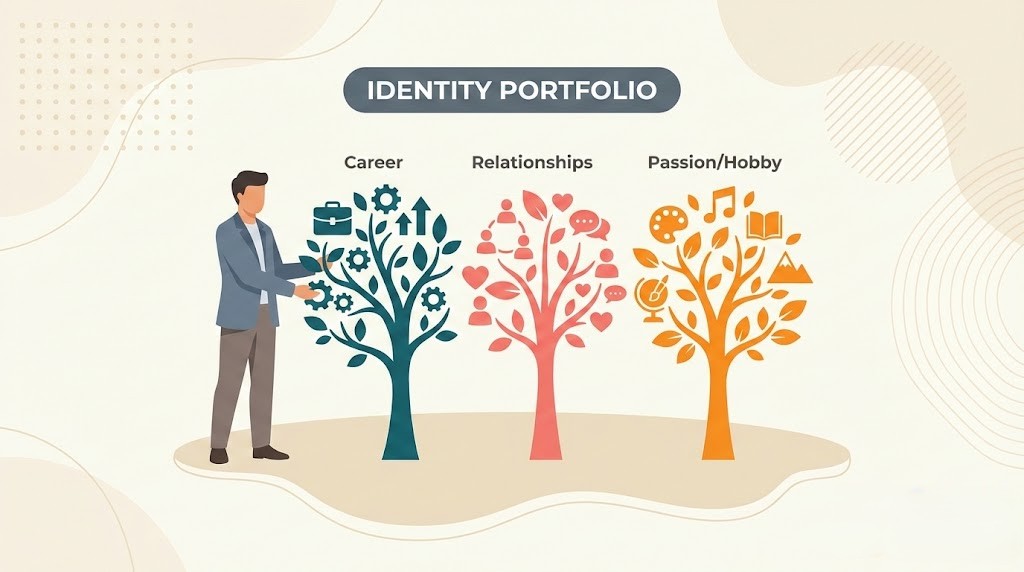
In investment, putting 100% of your capital into a single volatile stock is considered reckless. Yet, we do this with our lives. The ultimate solution to the identity crisis is ‘Identity Diversification.’
4.1 Building Multiple Sources of Meaning
You must cultivate ‘Identity Assets’ outside of your primary employment. These are not just hobbies; they are pillars of self-worth. According to the Deloitte Gen Z/Millennial Survey 2025, individuals who maintain active ‘side-hustles’ or community leadership roles report 30% higher job satisfaction and lower anxiety. This is because when one pillar shakes (e.g., a bad quarter at work), the others (e.g., your role as a community mentor, a parent, or an amateur athlete) remain stable, keeping the structure of your self-esteem intact.
4.2 Practical Steps to Launch Side Projects
Start small but be consistent. If you are a marketing director, do pro-bono consulting for a non-profit. If you are a developer, contribute to open source. If you love writing, start a newsletter. The goal is to hear “Thank you” and “Good job” from sources that do not sign your paycheck. This validates that your competence belongs to you, not your employer. By the time you face a career transition, you will not be starting from zero; you will be pivoting to an already active part of your portfolio.
References
- Challenger, Gray & Christmas, Inc., “The Challenger Report: December 2025 Job Cut Announcements,” 2025.
- Gallup, “State of the Global Workplace: 2025 Report,” 2025.
- Deloitte, “2025 Gen Z and Millennial Survey: Mental Health and Work,” 2025.
- Mental Health America (MHA), “Mind the Workplace 2025 Report,” 2025.
Disclaimer
This article provides general career and psychological information for educational purposes only. It does not constitute professional medical advice, diagnosis, or treatment for mental health conditions, nor is it financial or legal advice regarding employment disputes. Always seek the advice of a qualified professional for your specific situation.