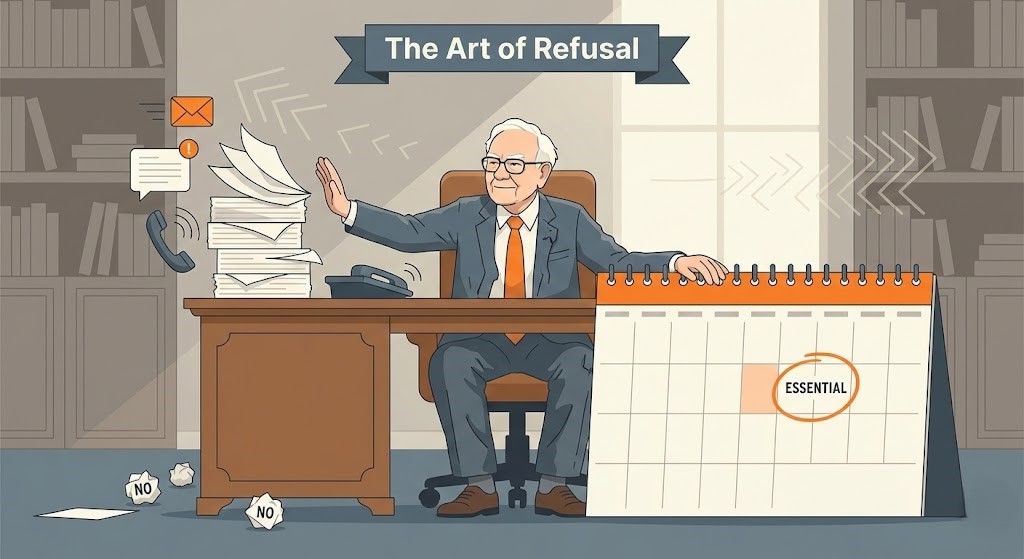
In an era where busyness is often mistaken for productivity, Warren Buffett, the Chairman of Berkshire Hathaway, stands as a quiet anomaly. While most executives boast calendars filled to the minute, Buffett is famous for keeping a nearly empty diary. This is not a sign of idleness but a result of a rigorous psychological framework designed to protect his most valuable resource: focus. From a neuroscientific perspective, the human brain is not built for multi-tasking; it thrives on deep immersion. Buffett’s approach utilizes the Pareto Principle and the concept of Avoidance to minimize cognitive load and maximize long-term compounding of results.
1. The 5/25 Rule: The Art of Brutal Prioritization
The 5/25 rule, famously shared by Buffett with his personal pilot Mike Flint, is more than a productivity hack; it is a philosophy of essentialism. Most people fail not because they have no goals, but because they have too many good goals that distract them from their great ones. Psychology suggests that having 25 goals leads to the Zeigarnik Effect, where unfinished tasks constantly drain your mental energy. By narrowing focus to just five, you eliminate the background noise that causes decision fatigue. The remaining 20 items are not just secondary tasks; they are the Avoid-At-All-Cost list because they are the most dangerous distractions—tasks you care enough about to pursue but not enough to master.
The 5/25 Strategy Comparison
| Step | The Common Approach | The Buffett Approach |
|---|---|---|
| Goal Setting | List everything you want to achieve | List your top 25 goals for the year |
| Prioritization | Try to work on the top 10 items | Circle ONLY the top 5 absolute priorities |
| The Remainder | Keep the other 15 on a To-Do list | Label the other 20 as Avoid-At-All-Cost |
| Energy Allocation | Diluted across multiple projects | 100% focused on the top 5 until completion |
| Outcome | Moderate progress on many fronts | Exponential mastery of the vital few |
2. The Circle of Competence and the Power of No
Buffett’s time management is inextricably linked to his Circle of Competence. He understands that time spent outside one’s expertise is often wasted or counterproductive. By saying No to 99% of opportunities, he preserves his mental stamina for the 1% where he has a definitive edge. Steve Jobs famously said that focus is not about saying yes to the thing you want to do, but saying no to the hundred other good ideas that there are. Buffett embodies this, often citing that the difference between successful people and very successful people is that very successful people say no to almost everything. This protects the brain from the Sunk Cost Fallacy, where we spend time on failing projects just because we’ve already invested effort into them.
Cognitive Efficiency Matrix
| Dimension | Reactive Management | Buffett Strategy (Proactive) |
|---|---|---|
| Daily Schedule | Managed by emails and meetings | Managed by reading and thinking |
| Decision Speed | Fast and frequent (Low quality) | Slow and rare (High impact) |
| Main Activity | Operational firefighting | Strategic contemplation |
| Asset Protection | Protects money/status | Protects focus/energy |
| Mental State | High stress, high fatigue | Calm, high clarity |
Furthermore, staying within your circle of competence reduces Cognitive Friction. When you work on what you know best, you enter a Flow State more easily, which according to positive psychology, is the most productive state of human consciousness. Below is a checklist to help you define your boundaries.
Circle of Competence Assessment
| Question | Evidence of Competence | Evidence of Distraction |
|---|---|---|
| Skill Match | Tasks align with core strengths | Tasks require constant external help |
| Output Quality | Consistent high performance | Average or fluctuating results |
| Energy Level | Task provides intrinsic energy | Task feels draining and forced |
| Decision Clarity | Intuitive and logical ease | Constant second-guessing |
| Long-term Value | Contributes to compounding growth | Temporary fix or short-term win |
3. Self-Diagnosis: Is Your Calendar Controlling You?
Before implementing Buffett’s strategies, you must understand your current baseline. Are you truly productive, or are you just active? Many professionals fall into the Activity Trap, where they confuse movement with progress. Use the following checklist to evaluate your relationship with time and focus.
Time Audit and Focus Checklist
| Audit Category | Green Flag (Strategic) | Red Flag (Reactive) |
|---|---|---|
| Morning Routine | Deep work on the priority 1 | Checking emails and notifications |
| Meeting Policy | Only attends when essential | Attends every invited meeting |
| Task Deletion | Regularly deletes non-essential goals | Keeps growing the To-Do list |
| Reading Time | Blocks hours for learning | Reads only short snippets or news |
| Boundaries | Firm No to distractions | People-pleasing and over-commitment |
4. Your Immediate Action Plan
Becoming the Oracle of Your Own Time does not happen overnight. It requires a radical shift in how you perceive opportunity. Today, I challenge you to perform a Focus Audit. Do not add more tasks; instead, find what to subtract. Complexity is the enemy of execution. By simplifying your life down to the essentials, you allow your talents to compound, just like capital in a value investment. Start by identifying the one thing that, if accomplished, would make all other tasks easier or unnecessary.
24-Hour Implementation Guide
| Timeframe | Action Step | Expected Outcome |
|---|---|---|
| Morning (30m) | Write 25 goals and circle the top 5 | Clarity of purpose |
| Midday (1h) | Cancel one non-essential meeting | Recovery of mental bandwidth |
| Afternoon (2h) | Uninterrupted deep work on goal 1 | Tangible progress on vital few |
| Evening (30m) | Reflect on the No of the day | Reinforcement of boundaries |
| Night (1h) | Reading without digital distraction | Knowledge compounding |
References
- Schroeder, A. (2008). The Snowball: Warren Buffett and the Business of Life. Bantam.
- Clear, J. (2018). Atomic Habits: An Easy and Proven Way to Build Good Habits and Break Bad Ones. Penguin.
- McKeown, G. (2014). Essentialism: The Disciplined Pursuit of Less. Crown Business.
Disclaimer
This content is for educational and motivational purposes only. While based on the documented strategies of successful individuals, individual results may vary. For specific business or financial advice, please consult with a qualified professional.