Picture this: You are in a meeting, explaining a critical bottleneck in your project. Your manager cuts you off with a wave of their hand, saying, “Don’t bore me with the weeds. Just give me the high-level strategy.” It sounds empowering, doesn’t it? But two weeks later, when the project collapses because that “weed” was actually a fundamental flaw in the API integration, who takes the blame? In 2026, this style of “Hands-off” leadership is no longer a sign of trust; it is a liability. With the 2025 Gallup report showing global employee engagement dropping to 21%, the leaders who refuse to get their hands dirty are not just losing projects—they are losing their people.
1. The Dangerous Myth of the “Visionary” Leader
For decades, we were told that great leaders focus on strategy and delegate the execution. This might have worked in a slower world, but in the fast-paced tech landscape of 2026, it is a recipe for disaster. When a leader disconnects from the “how,” they lose the ability to judge the “what.”
1.1 The Cost of Absentee Leadership
Many managers confuse delegation with abdication. They believe that by staying out of the details, they are empowering their team. However, the data suggests otherwise. According to the Gallup State of the Global Workplace 2025 report, employee stress remains at a record high of 41%, while engagement has slipped to 21%. Why? Because employees do not feel empowered; they feel abandoned. When a leader doesn’t understand the daily friction points—the software bugs, the resource gaps, the conflicting priorities—they cannot remove obstacles. They become “absentee leaders” who demand results without understanding the cost of achieving them.
1.2 The AI Disconnect
This gap is widening with the adoption of Artificial Intelligence. Microsoft’s 2024 Work Trend Index revealed a startling statistic: while 75% of employees are already using AI tools, 60% of leaders lack a vision for how to implement them. If a manager doesn’t understand the details of how AI hallucinations occur or how prompt engineering works, how can they lead an AI-driven strategy? They can’t. They are steering a ship they do not know how to operate.
| Feature | Old School “Visionary” | 2026 “Hands-On” Leader | Impact on You |
|---|---|---|---|
| Response to Problems | “Figure it out yourself.” | “Let’s look at the data together.” | Reduced anxiety and faster resolution. |
| Knowledge Base | Relies on reports and summaries. | Understands the tools and workflows. | Less time wasted explaining basic context. |
| Feedback Style | Generic (“Do better.”) | Specific (“Optimize this step.”) | Actionable growth and skill acquisition. |
2. Micromanagement vs. Mastery: Knowing the Difference
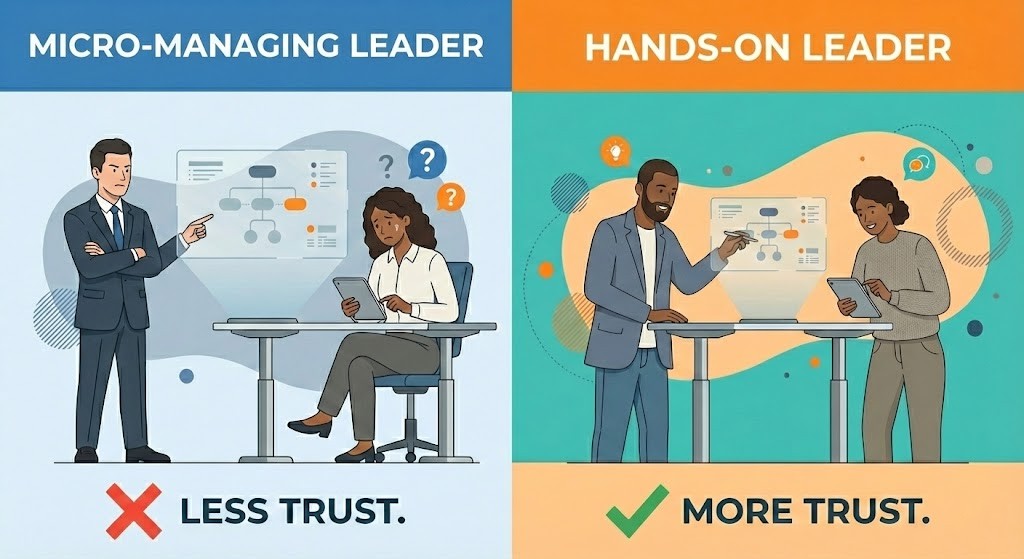
Whenever I advise leaders to “get into the details,” the immediate pushback is: “I don’t want to be a micromanager.” This is a fundamental misunderstanding. Micromanagement is about control; Hands-on Leadership is about context.
2.1 It Is About Teaching, Not Controlling
Micromanagers obsess over trivial details—font sizes, meeting minutes, or exactly when you log off. They do this because they don’t trust you. In contrast, effective hands-on leaders obsess over structural details—the logic of your code, the integrity of your data, or the customer journey map. As highlighted in a 2025 Harvard Business Review insight, the best leaders view themselves as teachers. They dive into the work not to do it for you, but to set a standard of excellence. They are checking the “load-bearing walls” of your project to ensure it doesn’t collapse.
2.2 The “Stochastic Sampling” Method
You don’t have to read every single email to be hands-on. Smart leaders use a technique often found in quality control: stochastic sampling. They will randomly pick one specific project or one specific customer interaction and drill down 5 levels deep. If they find quality there, they trust the system. If they find rot, they know the system is broken. This keeps the team on their toes (in a good way) and ensures standards are maintained without the leader becoming a bottleneck.
3. The NVIDIA Model: Why Details Create Speed
If you think knowing the details slows you down, look at NVIDIA. Jensen Huang, one of the most successful CEOs of our time, is famous for having 60 direct reports and zero 1:1 meetings. This sounds chaotic, but it is highly orchestrated.
3.1 Flattening the Information Hierarchy
Huang reads hundreds of emails a day from staff at all levels. He doesn’t do this to spy; he does it to keep a pulse on the ground truth. By removing the layers of middle management interpretation, he ensures that the “details” of the market reach the C-suite instantly. In a traditional company, bad news is polished and sanitized as it moves up the chain. In a hands-on culture, the raw data—the details—are visible to everyone. This transparency allows for rapid pivots.
3.2 Debugging the Process
When a leader is hands-on, they can act as a debugger. Instead of asking “Why is this late?” (which puts you on the defensive), they ask “Which specific step is slowing us down?” (which focuses on the process). This shifts the dynamic from blame to problem-solving. It requires the leader to understand the process well enough to ask the right question.
| Scenario | Hands-Off Approach | Hands-On Approach | Outcome |
|---|---|---|---|
| Project Delay | Adds more pressure/deadlines. | Reviews the workflow to find bottlenecks. | Root cause fixed vs. team burnout. |
| New Tool Adoption | Mandates usage without training. | Tests the tool first, then demonstrates. | High adoption vs. shadow IT usage. |
| Conflict Resolution | “Work it out amongst yourselves.” | Mediates based on facts/logic. | Fair resolution vs. political infighting. |
4. How to Cultivate “Hands-On” Skills (Without Burnout)
Whether you are a manager trying to stay relevant or an employee dealing with a vague boss, focusing on the right details is your career insurance.
4.1 For Leaders: The Zoom-In, Zoom-Out Technique
You cannot stay in the weeds forever. The skill is agility. Spend 10% of your week “Zooming In”—pick one process, one report, or one client issue and dissect it completely. Understand it better than anyone else. Then “Zoom Out” and apply that learning to the broader strategy. If you never zoom in, your strategy is a hallucination. If you never zoom out, you are just an expensive individual contributor.
4.2 For Employees: Managing Up with Details
If your boss is a “big picture” type who ignores reality, you must use details to protect yourself. Do not just present problems; present data. Instead of saying “We can’t do this,” say “Based on the current API limit of 500 calls per minute (detail), this strategy will crash the server (consequence). Here is an alternative.” Force them to see the reality through the lens of undeniable facts.
References
- Gallup, State of the Global Workplace: 2025 Report (2024 data).
- Microsoft WorkLab, 2024 Work Trend Index Annual Report (2024).
- Harvard Business Review, Are You Managing—or Teaching? (2025 Insight).
- Fortune, Jensen Huang’s Leadership Style and Flat Structure (2024).
Disclaimer
This content is for informational purposes only and does not constitute professional career counseling or legal advice. Workplace dynamics vary by industry and culture; please apply these insights with discretion suitable to your specific situation.