
Stop treating your lunch like a reward and start treating it like a resource allocation problem. Decision fatigue regarding meal choices is a silent leak in your daily productivity balance sheet. For high-stakes professionals, an unoptimized lunch leads to glucose variability, which directly correlates with a 15% drop in afternoon cognitive efficiency. We are shifting from intuitive eating to data-driven fueling, where AI algorithms dictate your intake based on real-time biological telemetry. Are you managing your assets, or are you just eating?
The era of generic nutrition is dead. AI is now the cold, calculating architect of your metabolism, synthesizing health check-up data and real-time bio-signals into a precise nutritional prescription. This is not a lifestyle trend; it is a competitive necessity in the modern knowledge economy. I will break down the mechanics of how you can leverage AI to eliminate decision friction and maximize your biological dividends immediately.
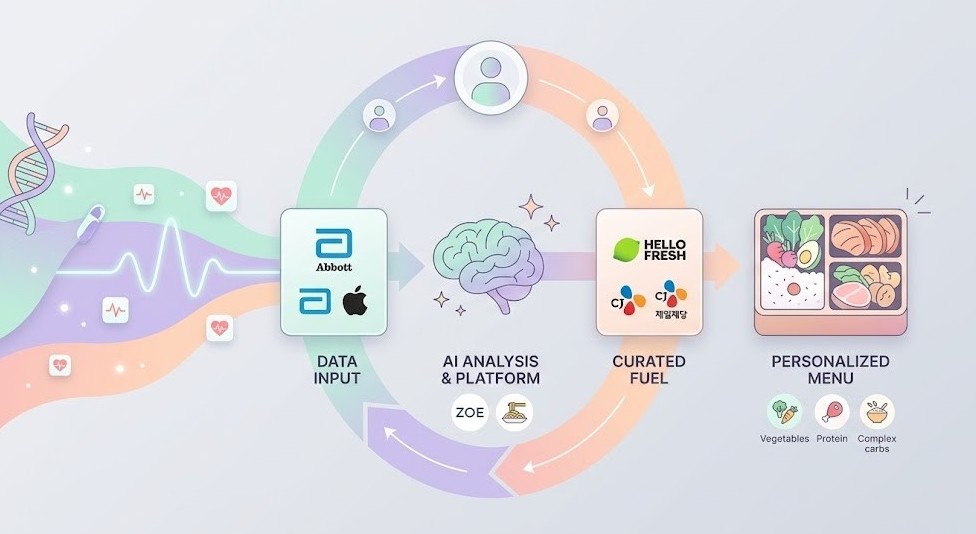
■ Biological Variance as a Data Optimization Point
Calorie counting is a primitive metric that ignores the complexity of individual metabolism. Modern AI utilizes Continuous Glucose Monitors (CGM) to quantify exactly how your body processes specific macronutrients. Since glucose responses vary by up to 40% between individuals for the same carbohydrate source, personalized calibration is the only way to ensure steady cognitive flow. AI serves as the bridge between raw sensory data and actionable nutritional intelligence.
🔍 [Deep Dive] The Architecture of AI Nutritional Engines
AI nutrition platforms utilize a multi-layered data stack. The foundation consists of Static Health Metrics (Genetics, EHR), overlaid with High-Frequency Telemetry (Real-time glucose, heart rate variability from wearables). This is then processed through Large Action Models (LAMs) that consider External Constraints such as local menu availability and ingredient supply chains.
By applying Bayesian inference, these models predict postprandial glucose responses with over 85% accuracy. This allows for the pre-emptive mitigation of the post-lunch dip, transforming a potential cognitive deficit into a period of sustained high-focus output. It is purely a matter of biological systems engineering.
🤔 Q. Is algorithmic nutrition more accurate than human expertise?
The question is irrelevant; the issue is scalability and real-time processing. While a nutritionist provides a snapshot, AI provides a 24/7 feedback loop. Human judgment is susceptible to cognitive bias and fatigue, whereas an AI model processes your log data with 100% consistency. In the context of performance optimization, an objective data set will always outperform a subjective opinion. Food is no longer about taste; it is about data integrity.
■ Industry Disruption: The Capitalization of Bio-Data
The global food industry is undergoing a structural pivot from volume-based manufacturing to precision curation. Market analysis indicates a CAGR of 14.4% in the personalized nutrition sector through 2030, driven by the convergence of healthcare and consumer tech. The value chain is being rewritten by those who control the data gateways.
| Value Chain Segment | Strategic Role | Key Moat / Risk Factor |
|---|---|---|
| Telemetry Hardware | Biometric data acquisition (Abbott, Apple) | Hardware ecosystem lock-in and sensor precision |
| Analytics Layer | Algorithmic meal prescription (ZOE, Level) | Proprietary LSI datasets and predictive accuracy |
| Distribution Node | Hyper-personalized meal delivery (HelloFresh) | Logistical unit economics and SKU complexity |
We are currently in the Early Growth Phase of the Personalized Nutrition Life Cycle. Tech conglomerates are aggressively pursuing healthcare data because metabolic telemetry provides the most granular view of human behavior. Your diet is the latest frontier for Big Data monetization. Recognizing this allows you to stop being a passive consumer and start being a strategic user of these systems.
🔍 [Deep Dive] The Emergence of the Glucose Economy
Capital is flowing into Biohacking startups because glucose management is the ultimate lever for productivity. For corporations, a workforce that manages its blood sugar is a workforce with higher uptime. We are seeing a Five Forces shift where supplier power is moving toward platforms that can verify the metabolic cleanliness of food products. In this economy, data transparency is the new premium brand signal.
■ Critical Assessment: The Cost of Optimization
Every optimization comes with a trade-off. In the case of AI nutrition, the primary risk is data sovereignty. Your metabolic profile is the ultimate ‘pre-existing condition’ record; its leakage to insurers or employers poses a significant socio-economic risk. Furthermore, total reliance on algorithms can lead to hedonic erosion—the loss of cultural and sensory diversity in the human experience. Optimization should be a tool, not a cage.
■ Action Plan: Hard-Coding AI into Your Diet
The time for theoretical debate is over. Implement these two protocols to secure your cognitive advantage starting today.
Step 1: Execute a Personal Health Data Audit. Feed your most recent health check-up PDF (de-identified) into an LLM. Use the following prompt: Analyze these metabolic markers and define my nutritional constraints. Provide a list of top 5 optimized lunch categories for a sedentary, high-focus professional and justify them with data. This establishes your baseline nutritional filter.
Step 2: Implement a Vision-Based Audit Loop. Before ingestion, use Vision AI to verify your plate. Prompt: Identify the macronutrient ratios of this meal. Calculate the probability of a glucose spike and recommend a consumption sequence to minimize metabolic impact. Utilizing the sequenced ingestion protocol (fiber -> protein -> complex carbs) based on AI verification will eliminate 90% of afternoon lethargy. Execute or be left behind.
📚 Technical References
🔔 Disclaimer
This analysis is for informational purposes only. It does not constitute medical advice or diagnosis. AI-driven recommendations are probabilistic and dependent on the quality of input data. Consult a medical professional before altering your metabolic management protocols.