
If you think a coding bootcamp is still the golden ticket to your child’s future, you are making a grave financial and temporal error. In 2026, the AI Education ROI is not measured by lines of code written, but by the strategic leverage a student gains over automated systems. Most parents are currently over-investing in skills that AI can perform for fractions of a penny, effectively preparing their children for obsolescence.
This report dissects the cold reality of the global educational race. We analyze the specific high-leverage skills emerging in the US, Japan, and Korea that will actually survive the automation wave. Efficiency is no longer enough; strategic orchestration is the only survival path.
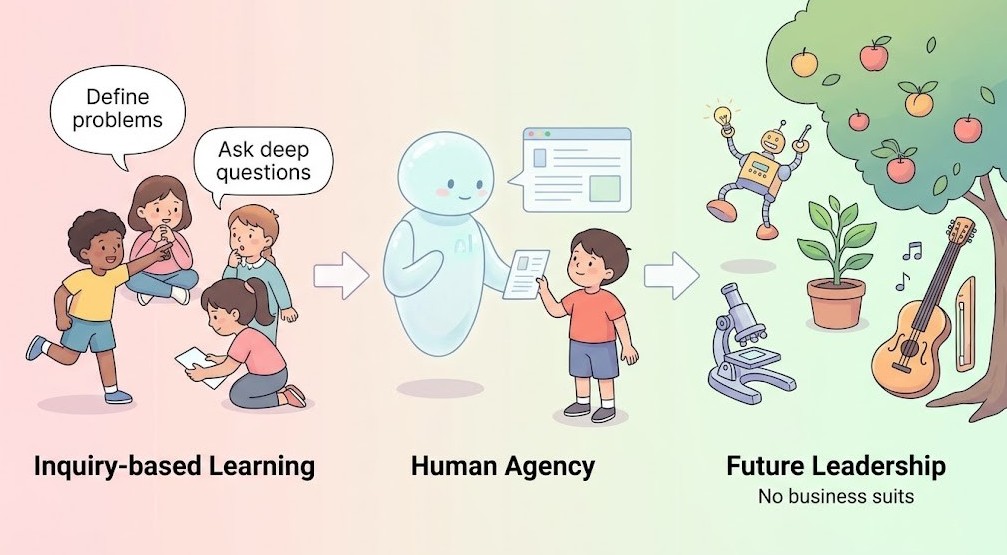
■ The Commodity Trap: Why Coding is the New Typing
Coding has transitioned from a high-value skill to a utility. LLMs have commoditized syntax, meaning the market value of a “pure coder” is plummeting toward zero. To maximize AI Education ROI, the focus must shift from technical execution to Strategic Problem Architecture.
🔍 [Logic Box] The Intelligence Value Chain
The value chain of modern work is divided into three tiers: Data Processing, Logic Execution, and Strategic Vision. AI has completely conquered the first two tiers. If your child’s education is stuck in Logic Execution (coding/calculating), they are competing against a machine with zero marginal cost.
High-value individuals are those who operate at the Strategic Vision level, using AI as a force multiplier. This requires a deep understanding of Systems Thinking and the ability to decompose complex problems into actionable prompts. This is the only segment of the value chain where human labor retains a premium price.
🤔 Q. Is STEM education a failed investment?
Only if it remains rote. STEM must evolve into STE(A)M, where the “A” represents the Analytical Art of managing AI systems. The technical foundation is still necessary to audit AI outputs, but it is no longer the primary driver of market value.
■ Geopolitical Arbitrage: Comparing US, Japan, and Korea
Understanding the national priorities of the leading tech hubs allows parents to hedge their children’s education against global trends. Each region is betting on a different facet of the AI Education ROI. Smart parents will synthesize the strengths of all three to create a globalized competitive advantage.
| National Strategy | Primary Skill Focus | Market Edge / Vulnerability |
|---|---|---|
| USA (Inquiry) | High-Level Questioning & Innovation | Market Disruption / Inconsistent Quality |
| Japan (Literacy) | Verification & Technical Rigor | Extreme Reliability / Cultural Inertia |
| South Korea (Efficiency) | Adaptive Speed & Standardized Gains | Mass Competency / Lack of Divergent Thought |
■ Risk Assessment: The Mid-Tier Obsolescence
The most dangerous place for a student in 2026 is the average middle. AI excels at performing average tasks exceptionally well. Students who are “pretty good” at math or coding will find themselves replaced by free software, leading to a hollowing out of mid-level white-collar roles.
We are seeing a bifurcation of the workforce. To avoid the trap, education must pivot toward Extreme Specialization or Broad Orchestration. Any educational path that does not integrate high-level AI prompt auditing is a legacy system that should be abandoned immediately.
■ Action Plan: Aggressive Skill Hedging
First, implement a “Zero Rote” policy. If an assignment can be completed by AI in 10 seconds, it is a waste of your child’s time. Force them to use AI to generate five different solutions and then critically evaluate the trade-offs of each. This builds the high-level decision-making skills that command high salaries.
Second, invest in Cross-Domain Synthesis. The most valuable future workers are those who can bridge the gap between AI technology and niche human industries. Combine AI Education ROI with deep expertise in ethics, biology, or law. The intersection of these fields is where the highest human-value premiums will be found in the coming decade.
📚 Data Sources for Analysis
🔔 Disclaimer
This analysis is based on current market trends and geopolitical data. Educational choices carry significant long-term risks. Readers are advised to perform their own due diligence regarding curriculum ROI and market demand.