
Retail investors are blindly chasing the Nvidia H200 AI Chips production restart, mesmerized by Jensen Huang’s $1 trillion inference market projection. Wall Street institutions, however, are looking at the exact opposite: the massive inefficiencies and bottlenecks created by this geopolitical gridlock.
This is not a market for blind optimism or diamond hands. The US-China export tug-of-war and the severe constraints in advanced packaging are creating extreme volatility. Smart money thrives on this chaos, extracting alpha from the supply chain’s weakest and strongest links.
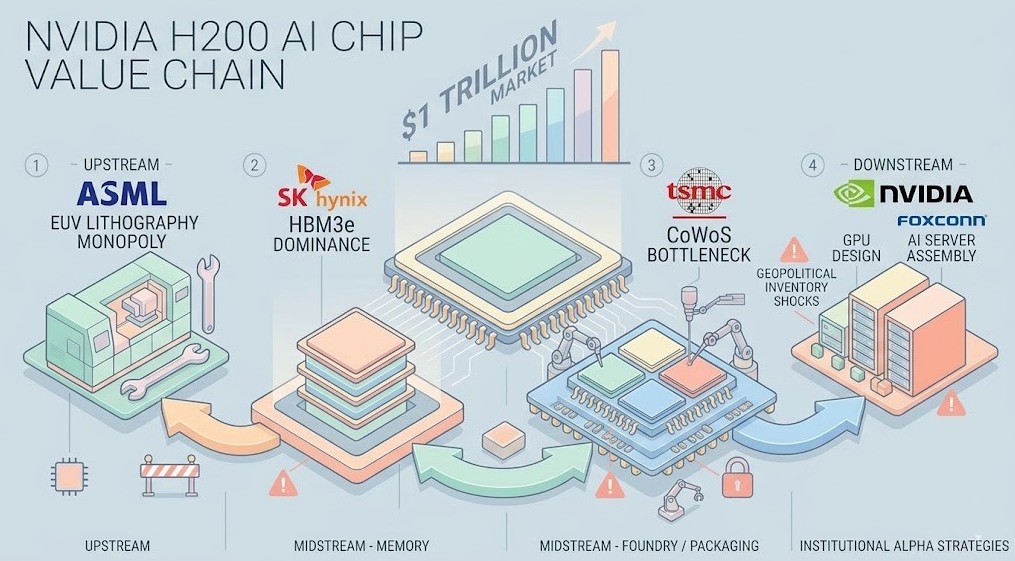
■ The $1T Illusion and the Institutional Edge
A $1 trillion Total Addressable Market (TAM) is utterly meaningless if Free Cash Flow (FCF) does not follow. The transition to inference workloads means hyperscalers are burning unprecedented CAPEX to secure hardware. The demand is undeniable, but the execution risk is astronomical.
While retail traders focus on the easing of export controls, institutional algorithms are tracking the exact opposite: China’s retaliatory import tightening. The mismatch between Nvidia’s massive purchase orders and actual customs clearance is creating a severe inventory bottleneck.
🔍 [Zoom In] FCF and Institutional Supply Dynamics
Institutional players do not trade the news; they trade the resulting capital flow inefficiencies. When Nvidia strategically halts H200 production to allocate TSMC’s limited CoWoS capacity to the Rubin architecture, it is a ruthless optimization of margins. This capacity constraint creates an artificial scarcity.
Those holding the monopoly on this scarcity dictate the terms. Memory vendors are already weaponizing this bottleneck, pushing for a 20% price hike on HBM3e. This is where the actual FCF turnaround occurs, moving capital away from speculative downstream players and straight into the coffers of the midstream gatekeepers.
🤔 Q. Who extracts the maximum rent from this geopolitical chaos?
Nvidia designs the gold, but it is the shovel-sellers who determine the mining rate. The absolute pricing power resides strictly with the midstream monopolies that physically bind the GPU and HBM together. TSMC is the ultimate rent-extractor in this ecosystem.
■ Value Chain Dissection: Follow the Smart Money
To generate alpha, you must dissect the Value Chain not by what companies make, but by their pricing power and FCF generation capability during periods of extreme stress. Capital flows to the path of least resistance and highest margin.
| Stage (Value Chain) | Key Players | Institutional Moat / Alpha Catalyst |
|---|---|---|
| Upstream (Monopoly Rent) | ASML | Absolute EUV monopoly / Immune to downstream margin compression |
| Midstream (The Choke Point) | TSMC, SK Hynix | Aggressive Pricing Power / Immediate FCF expansion from HBM3e hikes |
| Downstream (High CAPEX Burn) | Nvidia, Foxconn | Massive retail volume / Extreme vulnerability to geopolitical inventory shocks |
The institutional focus is intensely concentrated on the midstream. The absolute necessity of HBM3e for the H200 architecture grants SK Hynix a disproportionate amount of leverage over the entire ecosystem’s profitability.
💡 [Zoom In] The 2022 Neon Gas Crisis Blueprint
Wall Street has seen this exact supply chain extortion before. During the 2022 Russia-Ukraine conflict, the supply of semiconductor-grade neon gas was choked off. Retail investors panicked, but institutions aggressively shorted vulnerable logic chip makers while going heavily long on the few alternative suppliers who possessed absolute pricing power.
The current TSMC CoWoS packaging bottleneck is the exact same blueprint. The 0.001mm packaging limitation is the new neon gas. When Nvidia has to stall H200 lines simply because the packaging capacity is exhausted, the institutional play is to long the bottleneck itself. You do not buy the company waiting in line; you buy the toll booth.
■ Scenario Planning: Ruthless Market Variables
Risk management in this sector requires cold, calculated scenario planning. You must abandon emotional attachments to any single ticker and position your capital to profit from extreme binary outcomes.
| Macro Event | Institutional Action | Target Outcome |
|---|---|---|
| US-China Trade Gridlock | Short vulnerable downstream assemblers (e.g., Foxconn) | Capitalize on stranded inventory and collapsing margins |
| HBM Supply Shortage | Aggressive Long on SK Hynix during FCF turnaround | Capture the 20% structural price hike alpha |
If the upcoming geopolitical meetings fail, Nvidia’s balance sheet will instantly reflect a toxic spike in stranded inventory assets. Conversely, if the gates open, the midstream operates at over 100% capacity, and their margins will violently expand. Your capital must be positioned to exploit both extremes.
■ 2 Aggressive Alpha Generation Tactics
Stop praying for a broad market rally. The inefficiencies in the AI semiconductor supply chain require surgical, aggressive capital allocation. Open your terminal and execute these two strategies immediately.
First, exploit the HBM pricing power for an inventory arbitrage play. The projected 20% price hike for SK Hynix’s HBM3e in 2026 is a structural shift, not a cyclical blip. You must front-run the retail realization of this margin expansion. Screen your platform for the exact FCF turnaround points of key midstream vendors. Accumulate aggressively on any macroeconomic dips, effectively buying the toll booth before the traffic jam clears.
Second, deploy the SMH ETF as a ruthless volatility hedge. Holding naked long positions in Nvidia is an amateur retail strategy that exposes you entirely to single-point geopolitical failures. You must wrap your AI exposure by allocating at least 30% of your sector weight to the VanEck Semiconductor ETF (SMH). This forces your portfolio to own the upstream monopolists (ASML) and the midstream choke points (TSMC), ensuring you capture the monopoly rent regardless of which specific chip gets blocked at customs.
📚 Trusted Sources
🔔 Disclaimer
All investment decisions and responsibilities rest entirely with the individual investor. This article is provided for informational purposes based on verified facts and logical analysis, and does not blindly recommend buying or selling any specific stock. Please always keep market volatility in mind.